

What if a storybook could help parents manage their child’s anxiety?
Anxiety can be described as persistent, recurring intrusive thoughts or feelings, and physiological or behavioural responses that are considered disproportionate to the perceived threat. It is among the most common mental health concerns in children globally.
Anxiety typically emerges in early childhood and can significantly impair functioning across developmental stages. Typically, anxiety in children presents as avoidance of triggers or situations that make them anxious (for example, going to school), increased emotionality (like crying, tantrums) and cognitive challenges, including difficulty concentrating or impaired problem-solving abilities.
Despite the need for accessible interventions, it is estimated that more than half of children and youth experiencing mental health concerns do not access professional treatment.
This is especially true for children with “internalising” problems such as anxiety. In Ontario, for example, only 32% of youth who reported having anxiety were able to be seen by a mental health professional. Accessibility barriers include long wait lists, transportation barriers and financial constraints.
Our team at the Mary J. Wright Child and Youth Development Clinic at Western University [in Ontario, Canada] was interested in combining the use of storybooks that address anxiety or fears with the use of guiding questions informed by cognitive-behavioural therapy into a practical resource for families.
Parent-focused interventions
To address challenges to barriers in accessing mental health supports when there are concerns about anxiety, parent-focused interventions have been designed to provide guidance to caregivers who play a critical role in their children’s mental health and emotional development.
These interventions teach parents strategies to support their child’s mental health. This is about fostering positive parent-child interactions, promoting parental well-being and shaping more adaptive responses to their child’s emotional or behavioural challenges.
Although not a replacement for the direct guidance or involvement of a mental health professional, the increased interest in this approach recognises that parents have an important role in supporting new learning for their child, such as promoting coping tools and strategies for anxiety.
Some researchers have proposed that reading stories − both fiction and non-fiction − in dialogue with an attentive and caring adult could be a first step for children dealing with grief or anxiety.
Storybooks exploring experiences of anxiety
Storybooks enable children to feel less isolated with their experiences. They offer new opportunities to identify and label emotions and learn coping tools and strategies. A storybook for children with dental anxiety, for example, showed encouraging results in decreasing anxiety about dental visits.
Below are selected storybooks that explore different experiences of anxiety with guiding questions for parents. Questions are meant to reinforce key ideas, promote emotional awareness and help children connect the story to their own experiences.

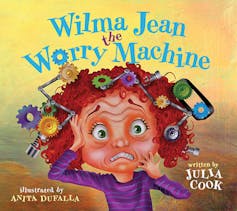
Wilma Jean the Worry Machine, by Julia Cook (Boys Town Press)
Wilma Jean the Worry Machine by Julia Cook is about a young girl who worries about everything, from missing the bus to making mistakes at school. With help from her teacher, Wilma learns to tell the difference between worries she can control and those she cannot, and begins to find ways to manage both.
Guiding questions:
- Wilma Jean shares a lot of worry thoughts, such as “What if I get picked last?” Do you ever have thoughts like this when you are feeling nervous?
- What do you think about sorting your worries into ones that you can and cannot control? How do you think this would impact how you feel?

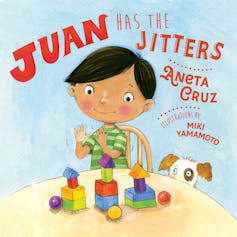
Juan Has the Jitters, by Aneta Cruz (Penguin Random House)
Juan Has the Jitters by Aneta Cruz is about a boy who gets a jittery feeling in his body when things feel unfamiliar, loud or unpredictable. With the support of his teacher, Juan is able to participate in a way that helps him feel settled and included.
Guiding questions:
- Have you ever felt the jitters? If so, what was going on while you were feeling this way?
- What sort of things do you do to help yourself feel calm?

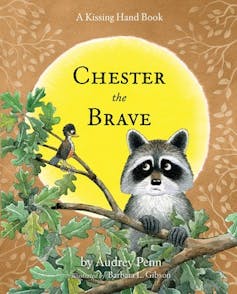
Chester the Brave, by Audrey Penn (Simon & Schuster)
Chester the Brave by Audrey Penn is about a young raccoon who learns that bravery means doing something even when you feel scared. With help from his mother, Chester practices the “think-tell-do” strategy: when he feels afraid, he tells himself he can do it and takes a step toward facing his fears.
Guiding questions:
- Chester and the little robin feel worried when they have to present in front of their class. Do you ever feel that way when you have to speak in front of the class?
- “Think-tell-do” is what Chester tells himself when he feels like he can’t do something. What could you tell yourself if you are having a hard time facing something?

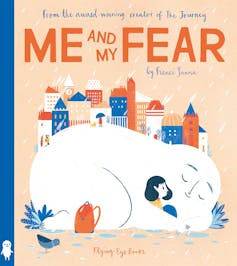
Me and my Fear by Frenci Sanna (Flying Eye Books)
Me and My Fear by Frenci Sanna is a story of a girl who has recently moved to a new country. In this unfamiliar place, fear begins to grow, making it harder for her to engage with others. As she befriends a classmate, she realizes others have fears. Slowly, her fear begins to shrink and she starts to feel more at home.
Guiding questions:
- Have you ever felt nervous or unsure about a new situation? What helped you feel a little better?
- When the girl notices that her new friend has a fear too, she begins to feel less alone. Have you ever realised that someone else felt the same way you did? How did that change how you felt?
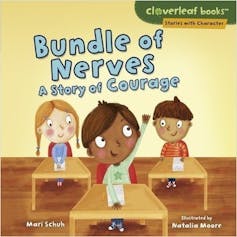
Bundle of Nerves, A Story of Courage, by Mari Schuh (Lerner Books)
Bundle of Nerves: A Story of Courage by Mari Schuh is about a boy named Luis who feels anxious on his first day of school. His nervousness shows up as a “bundle of nerves” in his stomach, but with encouragement from his dad, Luis learns that courage means doing something even when you feel scared.
Guiding questions:
- When Luis was feeling nervous, his dad told him to “have courage” Who do you talk to when you feel nervous? What do they say that makes you feel better?
- Luis was scared to ride the bus, but he did it anyway. Can you think of a time when you did something even though it felt scary at first? What happened after you tried it?
By combining evidence-based strategies with tailored storybooks, our Parent and Caregiver Resource Guide provides a practical, accessible way to support children experiencing anxiety.
This approach helps caregivers promote understanding, start conversations and support their children in building early skills for identifying and managing early experiences of anxiety.
This article is written by Colin King is director, Mary J. Wright Child and Youth Development Clinic, Western University; Amy Rzezniczek is a PhD candidate, School and Applied Child Psychology, Western University; and Rachel Krahn is a master’s student, School and Applied Child Psychology, Western University.
It is being republished from The Conversation under a Creative Commons licence. Read the original article.