




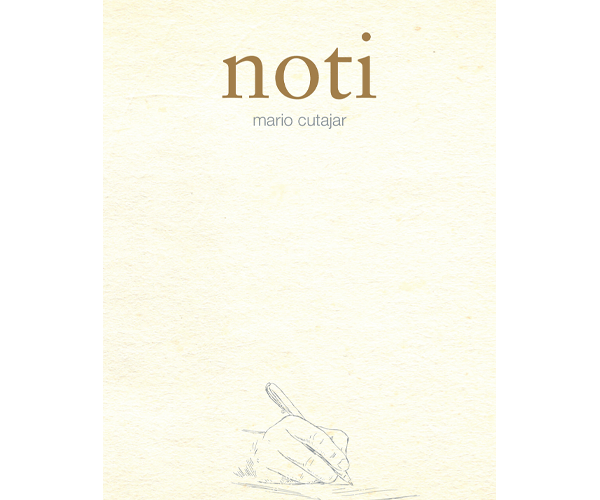
Mario Cutajar’s Noti (Klabb Kotba Maltin, 2025) is a distinctive and compelling addition to Maltese public administration literature − one that moves deliberately away from the detached, analytical tone of academic writing and towards something more intimate, interpretive and deeply human.
Published three years after the scholarly volume Public Service Reforms in a Small Island State: The Case of Malta, authored by Frank Bezzina, Emanuel Camilleri and Vincent Marmarà and published by Springer, NOTI enters the conversation from an entirely different angle.
Whereas the academic text offered a structured, evidence-driven account of reform processes in Malta’s public service, Cutajar’s memoir provides the experiential backdrop − the lived realities, personal encounters, frustrations and motivations that shaped the environment in which those reforms unfolded.
Cutajar served at the helm of the Malta Public Service and Secretary to Cabinet between 2023 and 2022.
Rather than being a continuation or critique of the earlier academic work, NOTI (notes) serves as its complement. Together, the two books form a rare dual portrait: one examining the Maltese public service from the outside through empirical analysis, and the other illuminating it from the inside through narrative, memory and reflection.
Cutajar’s book therefore enriches the existing scholarship by revealing dimensions of reform that cannot easily be captured in surveys, data sets or institutional histories.
A two-part narrative of experience and memory
Noti is divided into two substantial sections, each contributing differently to the book’s broader purpose.
The first section, ‘L-Esperjenzi miċ-Ċentru,’ (experiences from the centre) reads almost like an administrative diary. It documents Cutajar’s years at the centre of government, at a time when Malta’s public service was undergoing significant transformation. The chapter titles – ‘Il-Qafas għal Bidla’, (framework for change) ‘Arja Tqila’ (heavy air), ‘Tazza Nofsha Mimlija’ (a glass half full) – hint at a narrative defined not only by administrative tasks but by atmosphere, sentiment and human dynamics.
Cutajar’s depiction of the early days of the renewal process is especially vivid. In chapters like ‘L-Ewwel Passi’ (first steps), and ‘Kmamar Vojta’ (empty rooms) he describes a public service that had lost its sense of purpose in certain areas – symbolised by empty rooms, neglected spaces and organisational fragmentation. These descriptive moments function as metaphors for the broader challenges he faced. They show that reform is not only about structures and policies but also about restoring morale, clarity, and direction.
Where the Springer academic volume maps out reform components such as transparency, digitalisation, HR management and coordination, Noti delves into the emotional and cultural preconditions that made these reforms possible – or difficult.
Cutajar also writes candidly about the people who populated the service at the time. The chapter ‘Hemm Nies u Hemm Nies’ (there are people and then there are other kind of people) is emblematic: an acknowledgment that institutions are shaped by individuals with different degrees of commitment, talent and resilience.
Through anecdotes and personal reflections, he reveals how human behaviour – sometimes inspiring, sometimes resistant – was central to the reform narrative. This is precisely the kind of perspective that the academic literature cannot fully capture, making NOTI an invaluable interpretive supplement.
Memory, politics and identity beyond Castille
The second section, ‘Il-Belt u Lil Hinn Minnha’ (the city and beyond) broadens the scope beyond administrative life. Here, Cutajar intertwines personal memory with Malta’s political and social history.
Chapters such as ‘The Gut,’ ‘Mintoff,’ and ‘L-Gvern Laburista tal-1996’ (Labour Government of 1996) provide glimpses into the environment in which his administrative philosophy was formed. These reflections are not nostalgic digressions; they are integral to understanding how decades of political change, ideological shifts, and moments of national turbulence shaped his understanding of governance and public duty.
This section also underscores the continuity between Malta’s political history and its administrative evolution. Cutajar’s recollections of the reforms of the 1990s, the Labour Party’s transformations and various political transitions reveal a pattern: institutions do not evolve in isolation but in constant dialogue with societal forces.
“More than a recollection of career milestones, Noti is a testament to values − service, perseverance, leadership and integrity”
When he later writes about the more recent period of ‘twettiq’ (implementation) and the phases of transition that led to the reforms of the 2010s, the reader understands that these were not abrupt innovations but part of a longer narrative arc in Maltese governance.
The personal and political are inseparable in this part of the book, giving Noti a literary depth that distinguishes it from typical political memoirs. Cutajar does not present history as a backdrop; he presents it as a force that acted upon him and which he, in turn, tried to act upon through service and reform.
Dialogue with the Springer academic volume
One of the most illuminating aspects of Noti is the way it implicitly engages with the Springer academic book by Bezzina, Camilleri, and Marmarà. That volume provides a rigorous analysis of Malta’s public service reforms, covering their historical roots, thematic focus areas and empirical impact. It traces developments such as the enhancement of transparency, the modernisation of HR systems, policymaking reforms and the growing emphasis on digital governance.
NOTI, however, shows what such reforms look like from the inside: the tensions, the interpersonal negotiations, the cultural resistance and the moments of breakthrough. While the academic text presents reform as a sequence of institutional processes, Cutajar reveals it as a lived experience non-linear, challenging and profoundly human.
For scholars, this juxtaposition is invaluable: it merges the theoretical and empirical with the interpretive and personal, providing a fuller understanding of Malta’s reform trajectory.
A memoir with public purpose
More than a recollection of career milestones, Noti is a testament to values − service, perseverance, leadership and integrity. Cutajar writes not to settle scores or to glorify his role, but to share insight into how institutions can evolve when guided by conviction and clarity of purpose. His prose in Maltese is reflective and evocative, making the work accessible to both expert and general readers.
For students of public administration, researchers and practitioners, NOTI offers rare access to the human element behind institutional change. For the wider Maltese public, it provides an engaging narrative about the country’s political and administrative evolution as seen through the eyes of someone who shaped, and was shaped by, that history.
References
Bezzina,F., Camilleri, E. and Marmara, V. (2021). Public Service Reforms in a Small Island: State the Case of Malta. Springer.
Cutajar, M. (2025). Noti. Malta: Klabb Kotba Maltin.
Sakrawandi, S. and Kurniawan, Y. Book Review − Public Service Reforms in a Small Island State: The Case of Malta. Administrative Theory and Praxis, 47(1), 95-97