


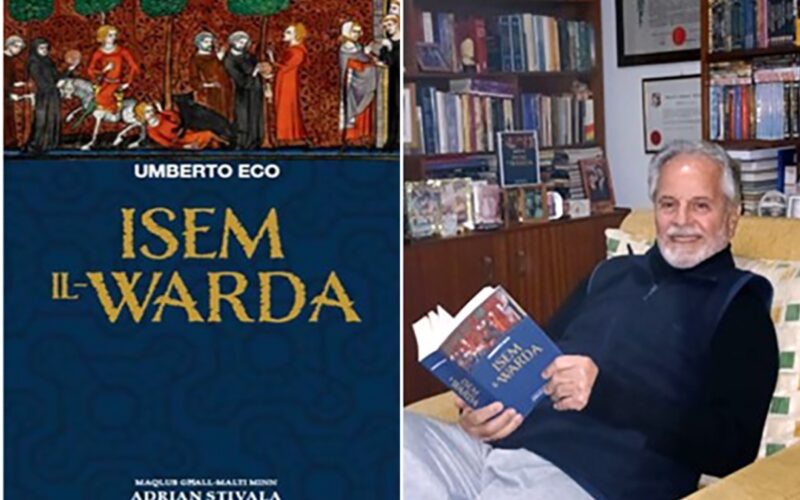
A translation into Maltese of Italian writer and philosopher Umberto Eco’s (1932-2016) novel Il Nome della Rosa was recently published by Klabb Kotba Maltin.
The Maltese version of this masterpiece has been given the title Isem il-Warda and has been carried out by Adrian Stivala, a university academic and translator, who took nearly 10 years to complete it.
Stivala admits the novel proved to be a challenge to translate on many levels.
Firstly, at the language level. The span of Maltese vocabulary, its semantic richness and other aspects were put to a severe test during the translation process.
“Umberto Eco’s Italian is complex, selective and innovative,” Stivala says.
In order to preserve the spirit of the original, even at the linguistic level, he had to explore the Maltese language thoroughly. Another challenge was the local reading public, with its exposure to a trilingual environment. Many Maltese speak Italian, besides English, and have a working knowledge of it, but may be less able to read a demanding work of modern literature such as Il Nome della Rosa.
“So why not give those who enjoy reading in Maltese the chance to get to know and enjoy this great book in their own language?” Stivala asks rhetorically.
“Umberto Eco’s Italian is complex, selective and innovative”
A third challenge was the content. Eco manages to blend standard narrative techniques with history, philosophy, theology, architecture, art, monasticism, religion − just to mention a few − into one homogeneous whole.
“Probably this is the secret behind the international success of the book,” Stivala notes, adding that the original, which sold over 50 million copies worldwide, was translated into over 40 languages, making it the most successful novel he published from the seven books he wrote between 1980 and 2015.
“On top of it all, and as a cohesive factor, this book is a detective story or murder mystery, with the difference that it is set in an early 14th-century Benedictine abbey where a medieval serial killer is at large.
“All this had to be put together using the Maltese language, saying nearly the same thing as the original in this translation.”
The publication, which is now available in leading bookstores, has been made possible with the financial help of the Malta Book Fund within the National Book Council as part of their endeavour to encourage the spread of knowledge of foreign literature in Malta at all levels.