

In a world that is saturated by visual noise and accelerated life, tranquillity has become a radical position, and to pause, to truly observe, is to resist the constant pull of distraction. Entering the quiet world of Richard Saliba’s paintings, renewed attentiveness reveals the rhythms of the landscape he inhabits.
Saliba (b. 1943) is presenting his latest series of 28 oil paintings in a solo exhibition at The Phoenicia Malta. Curated by Charlene Vella, the exhibition showcases artworks that explore the tranquillity of the Maltese landscape, highlighting the artist’s sustained engagement with its forms, light and atmosphere.
The artist has sustained a prolific artistic career spanning over five decades, exhibiting widely in Malta and internationally, with works held in major public and private collections. His formal training began at the Government School of Art, then continued in Italy, where he studied at the Accademia di Belle Arti in Perugia and the Istituto Statale d’Arte in Urbino.

Under the guidance of Esprit Barthet, Vincent Apap, and George Borg, Saliba was introduced not only to painting as image-making, but to painting as process: the preparation of canvas, the handling of primers and pigments, and the disciplined use of oils, solvents and varnishes. This technical grounding fostered sustained attentiveness to craft and an intimate, almost tactile relationship with the medium itself.
His debut exhibition, held in 1975 at the National Museum of Fine Arts in Valletta, marked a formative moment in which his artistic language began to crystallise. Rather than pursuing “great” art, his practice evolved organically, driven by sustained looking and a constant drive to understand what meaningful artistic expression might entail.
Over time, this approach developed into a recognisable personal language, moving away from his earlier hard-edged style towards a more expressive approach inspired by the Impressionists, Paul Gauguin, and David Hockney, among others.
Reflections of Tranquility exemplifies Saliba’s evolving practice, with each exhibition offering a moment to assess and reflect on his artistic development. As the title suggests, the artworks capture the quiet of the Maltese landscape, Mediterranean in essence but uniquely local.

Driven by a continual curiosity about what shapes this landscape, Saliba’s works attempt to engage with and convey this complexity. He finds inspiration in its unique terrain and Mediterranean light, often overlooked by those accustomed to it, prompting attentive observation of landscapes such as Wardija and Balluta Bay, where everyday familiarity risks dulling perception.
While Saliba draws inspiration from scenes he has personally encountered, his paintings are shaped by the reflective gaze of a thoughtful, humble artist. He states: “They may appear nostalgic or romantic, but this is simply how I perceive the world.”
Although there is a deep command of the medium, it becomes secondary to the personal imprint Saliba leaves on each artwork. The artistic process becomes a journey inward, made visible to those patient enough to see: “It reveals one’s true, unguarded self and allows others to glimpse who and what you are.”

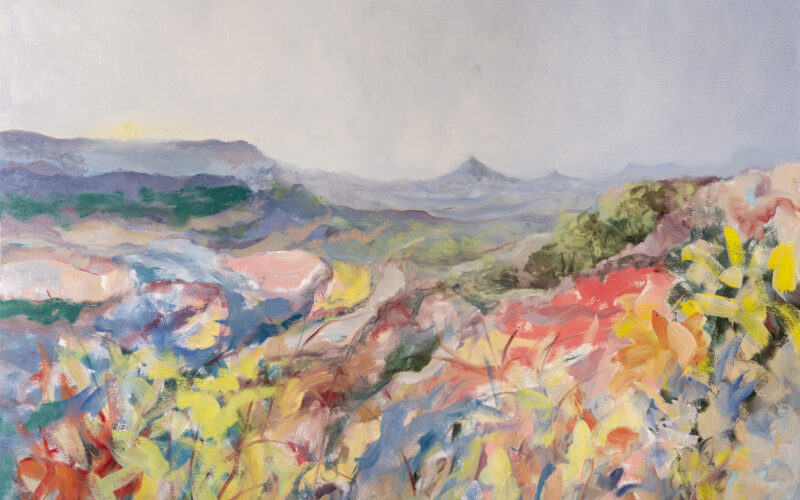
Building on this intimate vision, the space itself becomes a meditative setting, guiding visitors through the calm rhythms of Saliba’s landscapes. The curation visually emphasises this rhythmic flow from one painting to the next through subtle echoes in palette or brushwork. This distinct visual language lies not only in Saliba’s choice of pigments, but in how he handles them.
The ability to mix colours with precision is developed through extensive trial and error, and achieving balance within a composition is a delicate process, as seen in the incorporation of the luminous lemon yellow. Contrasts between warm ochres and cool azures further heighten this effect.
This is evident in several of his Gozo landscapes, which make up nearly half of the artworks on display, underscoring a balanced representation of the Maltese islands. These colours reflect and refract light in a manner that suggests atmosphere rather than detail, where each hue, in dialogue with its neighbouring tones, articulates a careful balance between colour and light.

This atmospheric approach creates a sense of space within space, shifting the emphasis away from minute detail to perception and mood. Saliba’s brushwork allows fragments of landscape to verge on the abstract, as form dissolves into colour and gesture, as seen in works such as Għolja tas-Salvatur and Mtaħleb. The resulting vibrancy and fleeting emotional charge are not attempts to capture a fixed moment, but rather emerge from the artist’s sustained engagement with his surrounding environment. These works remain fluid until the final brushstroke.
Even within the context of this exhibition, one or two paintings were still wet in the days leading up to the opening, underscoring Saliba’s ongoing dialogue with his medium and the openness of his working process.
Ultimately, Reflections of Tranquility invites the viewer into a space of attentiveness. In an era dominated by visual excess and immediacy, Saliba’s paintings ask for patience and reward sustained looking with quiet intensity. The landscapes do not seek to impress, but to remain open to be viewed within one’s own pace.
As Saliba says: “I paint primarily for myself, and if others respond to the work, that is an added satisfaction.” It is this unforced stance that allows the exhibition to resonate.
Reflections of Tranquility is open to the public until Sunday at the Palm Court Lounge, The Phoenicia Malta.