
Artist and researcher Raphael Mizzi was in a nondescript waiting room when his eye caught a magazine from the 1990s.
Within the crumpled and creased pages of the decades-old journal was an article about an expedition that circumnavigated the globe using only surface transport.
“From that moment I couldn’t stop thinking about doing something like that,” Mizzi said.
Years later, Mizzi left his Tarxien home and started his own journey. He left Malta in January last year and returned nine months later.
Like the expedition he had read about, Mizzi’s plan was to encircle the Earth without getting on a plane.
From Malta he arrived at the tail end of south-east Asia in eight months but there realised he would need far more than the time he had planned to circumvent the globe.
He left Malta for Italy and then travelled through Greece, Turkey, Georgia, Kazakhstan, Uzbekistan, Kyrgyzstan, China, Taiwan, Macau, Laos, Thailand, Malaysia, Singapore, Indonesia, and finally Timor-Leste, from where he continued his travels by air.
Besides taking it on as a personal challenge, Mizzi said he wanted to travel without flying to experience as much local culture as he could.
“I didn’t want to go to touristic sites or locations you could easily get to – I wanted to go through places that are only known by locals to get a real feel of wherever I was, so I decided not to travel by air,” he said.
Mizzi said he also wanted to cross as many country borders as possible.
“Borders always fascinated me – on one hand it’s just an imaginary line but on the other you’re entering a new culture with a different language, cuisine and currency,” he said.
This week, the artist is opening his exhibition – Seven Encounters – about his eight-month flightless journey that ended 12,500 kilometres from where it had started.
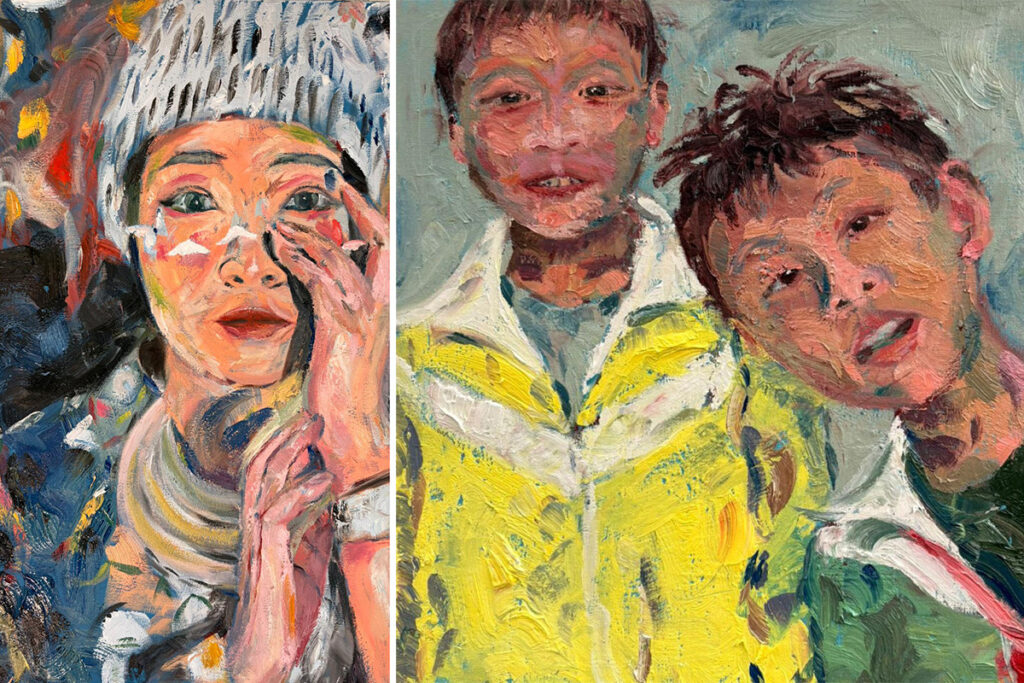
“The Seven Encounters represent seven people I met who I felt left an impact on me. Some helped me in any way they could – others guided me – and others showed a lot of generosity to me, a stranger.”


Among the oil paintings on show is a portrait of a Chinese woman in traditional dress.
“In China I learned that it’s common for people to dress in traditional costume and take photos either in parks, museums, or historical sites,” he said.
Mizzi said he met the woman portrayed soon after he entered China.
“After I left her city, she remained in touch, telling me where I should go and what to do,” he said.
Another painting, Kinmen Boys, was inspired by two children Mizzi saw soon after reaching Taiwan.
“In China everyone is dressed in grey or black, but as soon as I entered Taiwan everyone was dressed in bright colours.”
The exhibition is opening tomorrow, March 12, at 7.30pm at KUNĊETT in Strait Street, Valletta.
It will remain open until the end of the month.