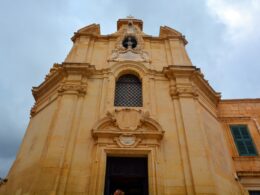


A wonderful kind of chaos has taken over MUŻA, the National Community Art Museum in Valletta. The Malta Pavilion of the biennale is now open, inviting visitors to cross the threshold from the reality we know into a series of dream-like installations and artworks designed to make us question our perception of modern life.
Titled Wonderland: Kaos Kontemporanju, the Malta Pavilion takes inspiration from the classic tale of Alice’s Adventures in Wonderland, inviting visitors to the museum through an immersive journey that is almost hypnotic in parts.
Curator Katya Micallef, who’s also principal curator at the museum, has done an excellent job creating a pavilion in which physical movement and mental reflection unfold in parallel.
The space hosts works by five of Malta’s most well-known names in contemporary art: Pierre Portelli, Vince Briffa, Roderick Camilleri, Victor Agius and Ġulja Holland.
As we make our way through the rabbit hole, our thoughts are guided through a set of layered contemporary concerns. The pavilion cleverly presents concepts and materials that, when taken at face value, embody progress and innovation. But something else simmers beneath the surface and, as we slowly take in the works, breaking down their layers, unsettling questions start picking at the edge of our consciousness.
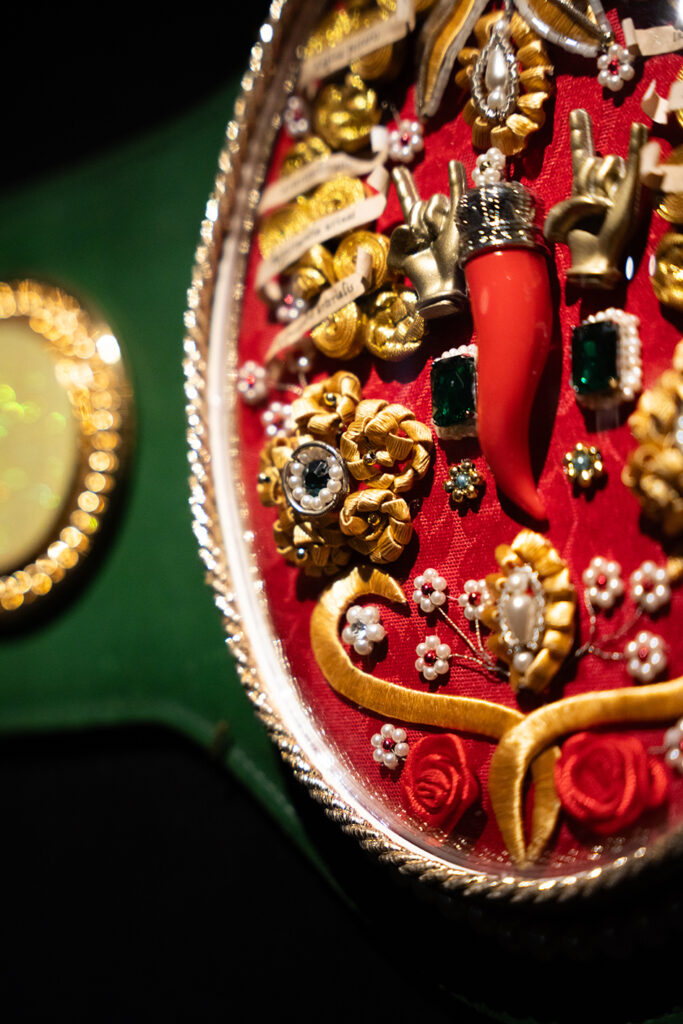
Our walk starts in The Triumph of Time by Portelli, presenting a series of championship belts that are transformed into colourful reliquaries with layers of symbolic materials from ganutell flowers to fake nails, syringes, gem stones, ribbons and even the infamous Maltese qarn. The effect is visually mesmerising, but mentally disorienting, forcing you to stop, question and discuss, just like the caged drone that commands the attention upon walking the space. The latter is a particular stroke of genius, flipping the script and turning an object of surveillance into the one being surveyed.
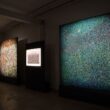
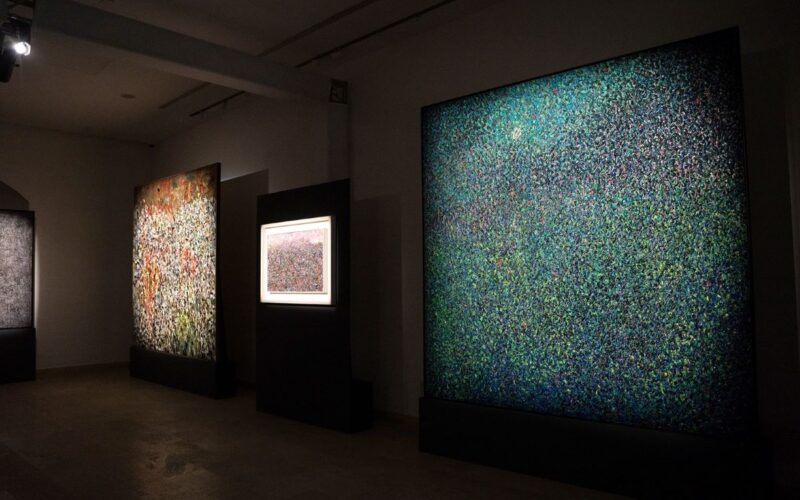
Sharing the same space within the Camerone Hall is FARO: Landscape Twice Refracted, consisting of five mixed media works by Briffa, most of them large-scale. The initial effect is overwhelming, a chaotic cacophony of contrasting colours trying to pull you in different directions. As you allow yourself to move beyond the initial superficial impression, small details, textures and a multitude of layers start popping out. Each work contains worlds hidden behind others, birds peeping out of corners,
Labyrinthine roads take us deeper down the rabbit hole. The effect is hypnotic, rendered more so by a lighthouse beam that revolves periodically, illuminating and blinding us in succession. It’s an effective way of hinting at the tensions between visibility and understanding. In a culture that’s obsessed with exposure, insight doesn’t always follow.
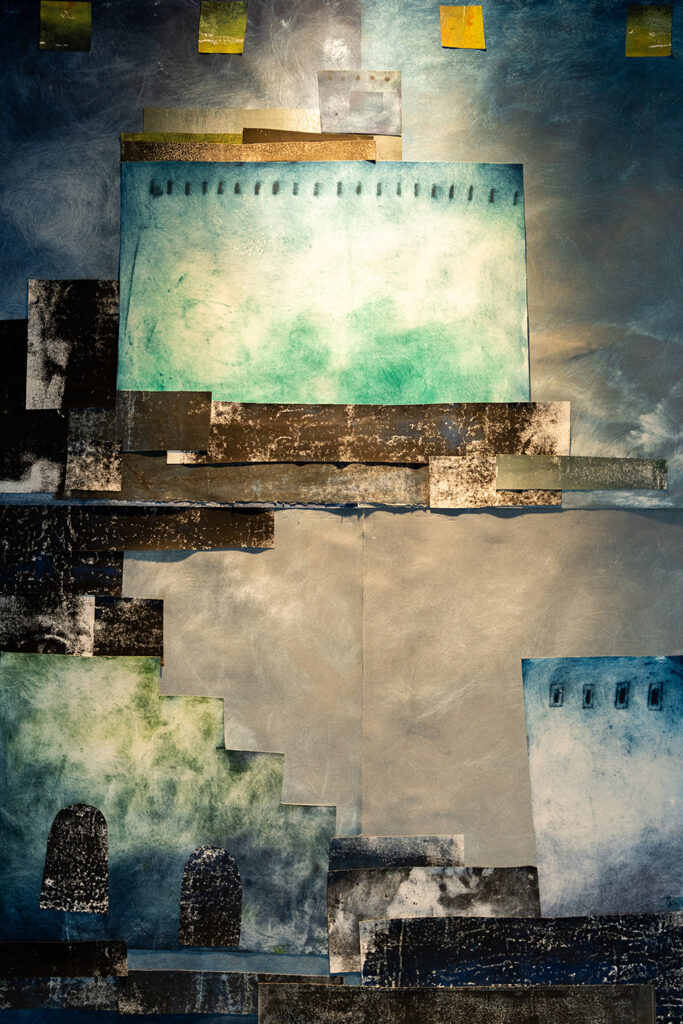
The next stage of the journey presents us with Our City: A Map of an Imaginary Nowhere, where Camilleri creates a reimagined Valletta that wears its heritage and collective memory proudly, almost as scars.
Real-life landmarks, such as the iconic arches of the Lower Barrakka Gardens, are instantly identifiable but what makes Camilleri’s works so compelling is that none of them give us a straightforward representation of the city. The interplay between the familiar and the transformed, coupled with the vertically layered composition, imbues the city with a dreamlike, surreal presence. Seen through Camilleri’s lens, Valletta shifts from a physical place into a fragmented memory, malleable to our perception.
In a quasi-liminal passage, we are then led to the next phase of this Wonderland with KHAOS: Thresholds of the Anthropocene. Here, Agius refuses to give a simplistically apocalyptic reading to the Anthropocene, instead creating a condition suspended between ruin and preservation, collapse and renewal.
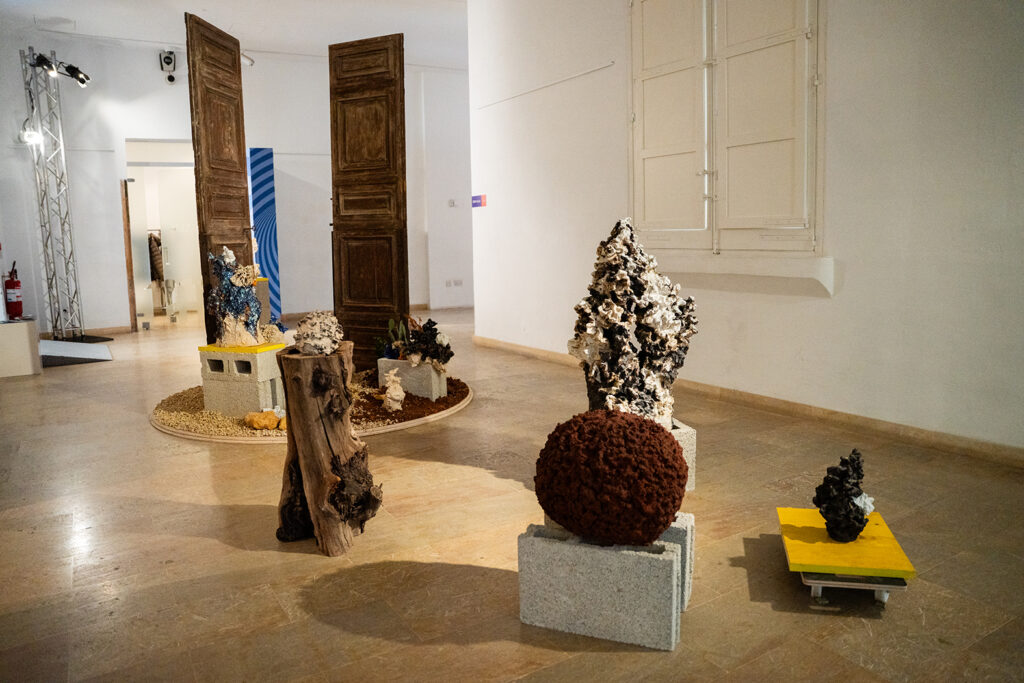
Agius offers us a nuanced reading of the environmental crisis we’re facing, unafraid to show the seductive beauty in the destruction, while simultaneously forcing us to face the vulnerability of the landscape we’re changing.
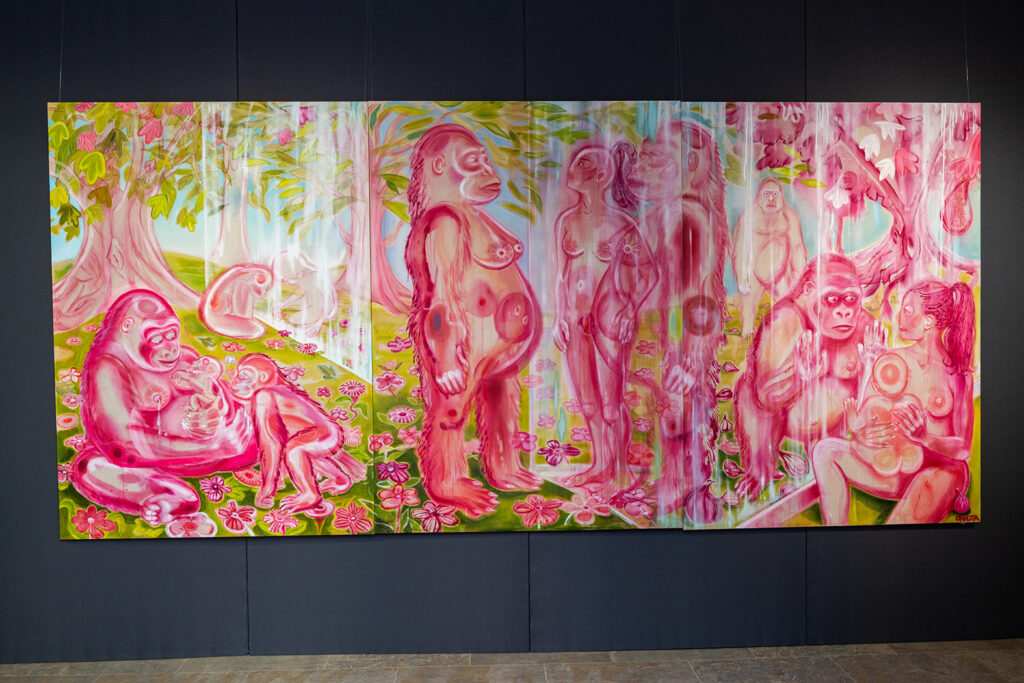
Finally, the journey comes to an end with Through the Looking Glass by Holland. Holland’s work doesn’t announce its ethical implications too loudly. Instead, it allows us to create our own interpretations of the interplay between gorillas and humans. The soft, pink hues create an almost joyous, hopeful aura.
But the tensions emerge gradually, drawing us into questions about spectatorship, power and captivity.
Holland’s work links beauty with discomfort, presenting us with a tableaux that’s serene on the surface, but that gradually exposes the uneasy power dynamics beneath the image. The mirrored surfaces quietly implicate the viewer, folding our own reflection into the scene and making us part of the uneasy exchange of gazes.
And it’s precisely this dichotomy between surface beauty and deeper turmoil that binds the works of the Malta Pavilion together, turning the words ‘Clean | Clear | Cut’ from an abstract theme into a sharp curatorial proposition revolving around the difficult questions of mortality, surveillance, heritage, memory, environment and power.
The Malta Biennale 2026 runs until May 29. Tickets and full details about the exhibitions, artists, pavilions and events are available at maltabiennale.art.