
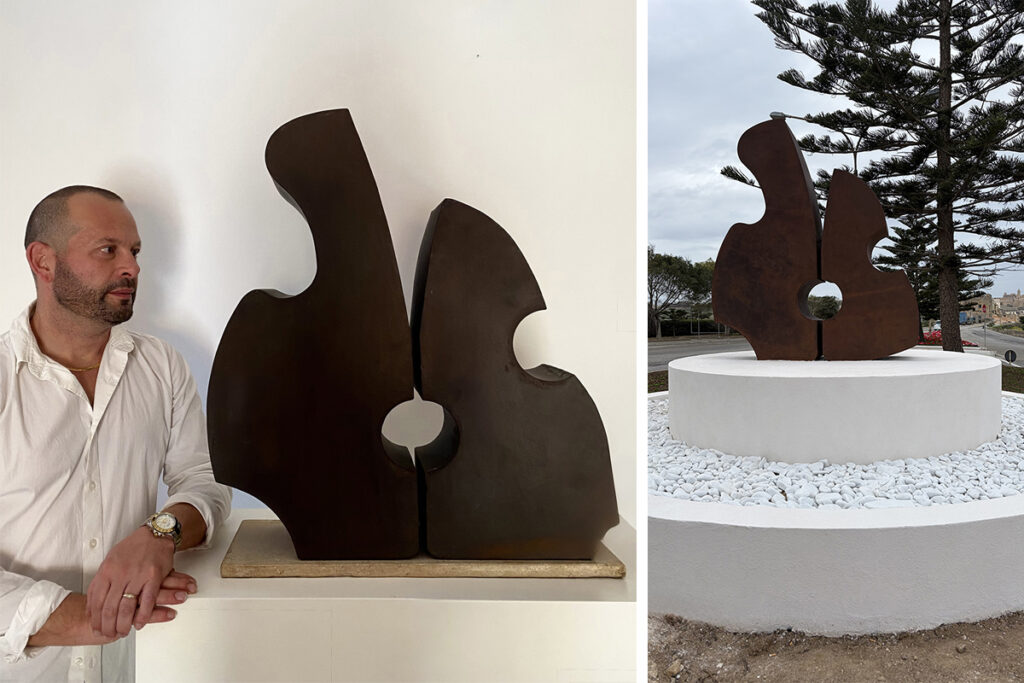
Anyone driving across Gozo in recent weeks may have noticed a striking new landmark on the roundabout between Victoria and Nadur, at the point where the road branches uphill towards Xagħra. Rising prominently from the landscape are two contemporary steel forms that together make up Encounter, a new public artwork by Gozitan artist Christopher Saliba, funded by the Ministry for Gozo and Planning through its Public Art Scheme.
The sculpture forms part of the ministry’s ongoing investment in public art as a way of enriching Gozo’s open spaces, strengthening the island’s cultural identity and bringing contemporary artistic expression closer to everyday life. In Encounter, that vision takes shape through a work that draws deeply on Gozo’s prehistoric legacy while speaking in a distinctly modern sculptural language.
“The temples were my inspiration for these ‘modern megaliths’,” Saliba says, “and the position where my artwork stands now is meaningful to me as Xagħra is my town of origin and Nadur is where I currently live and am bringing up my own children. I grew up just a stone’s throw from Ġgantija and during my childhood I was able to roam around the area and play among the stones. I used to think of it as a magical place. Now, of course, the site is carefully protected, and rightly so, as it’s important to preserve it for future generations.”
He explains that he chose to create a sculpture consisting of two upright megaliths to pay homage to these ancient temples, and, positioned where it is, it serves as a contemporary way-marker for visitors to Xagħra and Ġgantija.

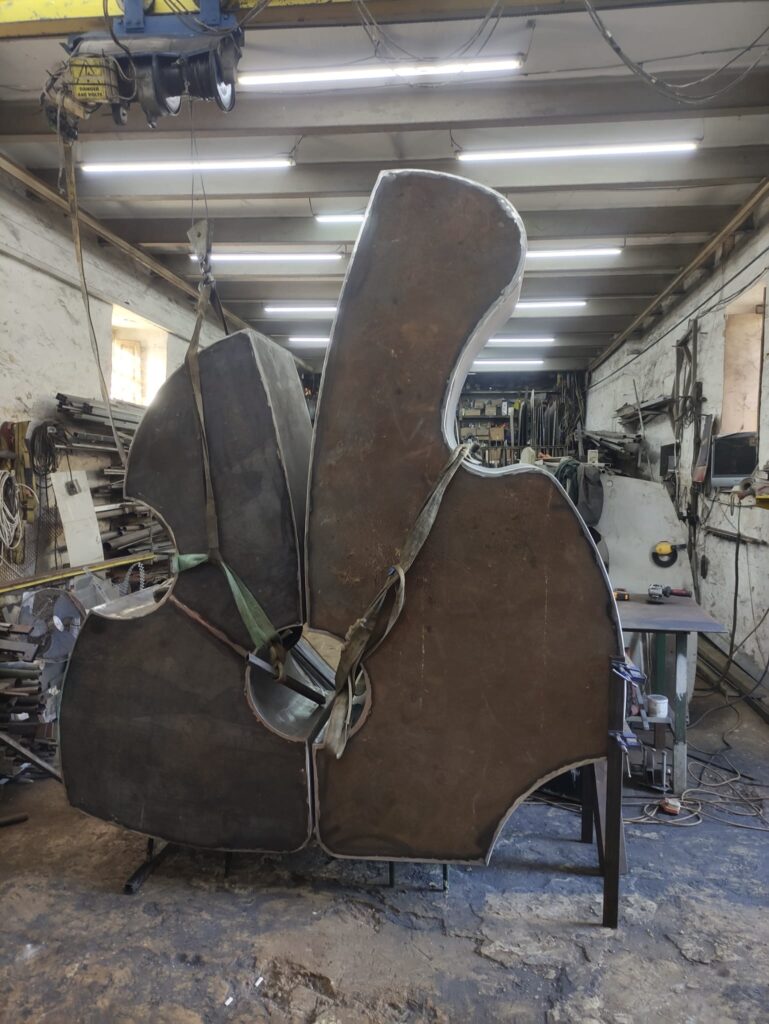
“I envisaged the sculpture as two separate totemic ‘stones’ coming together. Apart from considering the artwork’s aesthetic attributes, I also had in mind the alignment of the past and present as the underlying concept; by valuing our past, we are in a position to safeguard our heritage for our children and yet, because the sculpture is made with cutting-edge technology and precise computer-aided processes, we are also celebrating mankind’s progress,” he continues.
The metallic structures stand close and yet do not touch. At the heart of the pair, there is a circular cut-out scooped from their centre that allows the light through. This feature is comparable to the oracle holes found in the neolithic stones at Ġgantija − carved holes which, presumably, had important seasonal and ritualistic functions.
“The circle that forms as they stand together also represents the circle of time,” Saliba adds.
“Positioned where it is, it serves as a contemporary way-marker for visitors to Xagħra and Ġgantija“
Saliba opted for a minimalist design for maximum impact, which he first modelled in clay. The final forms, which stand 2.5 metres tall, are influenced by both the stark monumental work of US sculptor Richard Serra, whose pieces have a weighty and austere drama, and the softer, more organic forms created by British sculptors Henry Moore and Barbara Hepworth.
“I love the almost prehistoric feel of their work, which is part inspired by Stonehenge, and the softer shapes that they use. I have used those same feminine curves as they remind me of the Venus and Goddess figurines found in our own Neolithic temples,” he says.
The choice of the material for the sculpture was also an important consideration, as it makes for a big contribution to the look and ‘feel’ of a piece, he continues.
“I opted for a material that would be striking yet tone with the landscape. I chose Corten Steel or ‘weathering’ steel, which oxidises and develops a homogenous reddish patina. Corten steel is used in the construction of ships and outside structures because this oxidation gives the metal a measure of protection and increases its resistance to external forces.
“There may be some natural staining over time but that’s part of the plan: over time, nature changes the landscape we live in, and so it’s appropriate that it can affect the sculpture too.”
Saliba adds that he also chose Corten steel because of its reddish hue.
“There is evidence that the internal walls of the Ġgantija Temples were painted with red ochre, a naturally occurring pigment, and therefore matching that age-old colour seemed appropriate. Also, anyone who is familiar with my paintings knows about my affinity with red: it’s such an intense and dramatic colour.”

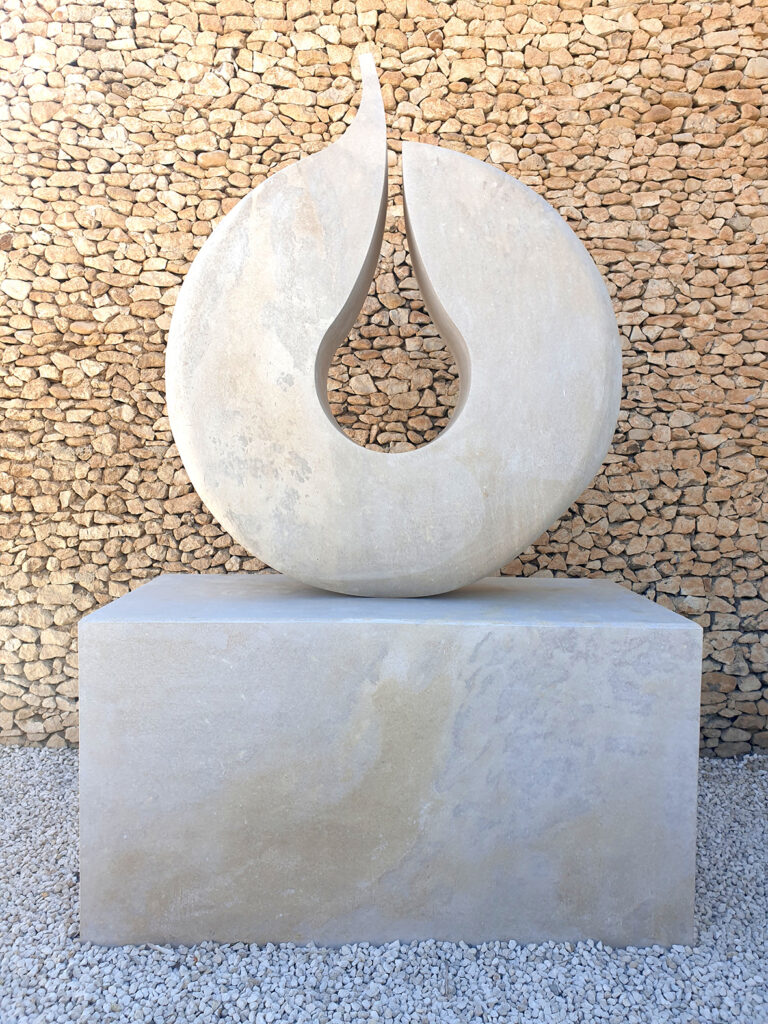
As an artist, Saliba has built a reputation over many years as a prolific and popular landscape artist known for his vibrant expressionist paintings. Encounter is only his second foray into sculpture on this scale. (The first was Drop, a three-metre-high minimalist sculpture made from Maltese hardstone in 2021 that stands outside the Water Services Corporation building in Ħondoq.)
It is interesting to draw comparisons between his latest creation in steel and his paintings. Both are inspired by the natural treasures of Gozo, as well as its heritage.
When painting, Saliba focuses on the essence of a scene and simplifies the ‘visual data’ his eyes see. Each is a personal interpretation of his surroundings, rendered in a distinctive style with a colourful palette and rich textures. In his sculptures, Saliba simplifies the shapes he perceives, moving towards complete abstraction.
His forms are minimalist in comparison with his expressionist paintings, and their surfaces are usually smoothened to perfection, unlike his thickly textured impastos on canvas. However, both his paintings and sculptures encapsulate the spirit of the landscape, and in both media he celebrates the beauty of their essential forms with lyrical lines and dramatic strength.
In position, Encounter’s contemporary megaliths look as if they could represent the harmonious coming together of human forms. They are equally reminiscent of a violin or cello, giving a sense of joy and even evoking the music of a celebratory community.
The sculpture was inaugurated by Minister for Gozo and Planning Clint Camilleri on March 27.