
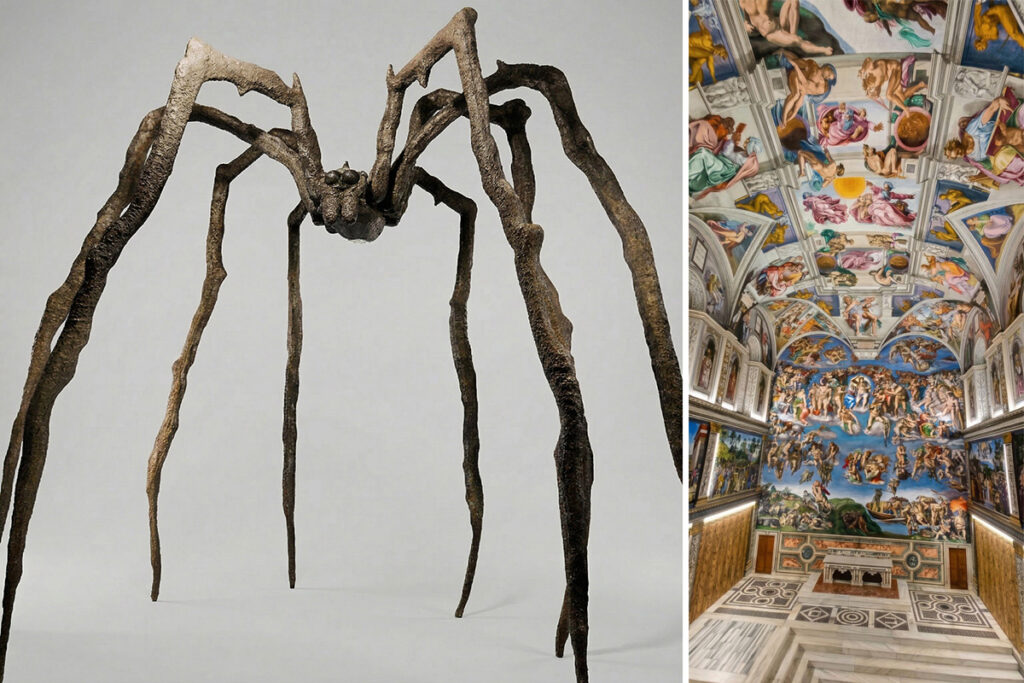
Contemporary art aesthetics unfold within a language in which the very notion of originality has been profoundly destabilised. From Marcel Duchamp’s placing of a mass produced urinal inside a museum to Andy Warhol’s serial reproductions of consumer imagery, reproduction has long ceased to be secondary to originality. Rather, it has become a critical strategy through which artists interrogate authorship, authority and the status of the artwork itself.
It is precisely within this reconfigured terrain − where the boundaries between original and reproduction are increasingly shifting − that one should interpret Untitled (2018) by Maurizio Cattelan, currently exhibited at the Grand Master’s Palace, Valletta, as part of the Malta Biennale 2026.
Inside the Grand Master’s Palace, one is unsettled by the peculiar dissonance of stepping into Untitled: a meticulously crafted, walk-in miniature replica of the Sistine Chapel. Cattelan’s reduced chapel, however, does more than replicate a canonical space. It stages a confrontation between original and copy.
At first glance, the work appears almost playful − a 1:6 scale replica, complete with hand-painted copies of Michelangelo’s ceiling frescoes and The Last Judgment. But the longer one remains inside this compressed sacred space, the more its conceptual force unfolds. The familiar becomes strange. The monumental turns intimate.
Cattelan’s gesture − copying − does not simply imitate. The original Sistine Chapel remains in Vatican City, saturated with centuries of religious, political and artistic authority. But here, in Valletta, its scaled-down double acquires a different kind of presence.
“Copying, far from being derivative, becomes a critical tool”
Inside the structure, the experience is uncanny. The proportions are humanised. The overwhelming verticality of the original chapel − designed to dwarf the viewer and elevate the divine − is within one’s reach. The frescoes, usually glimpsed from a distance and often obscured by crowds, now unfold at eye level. One notices details that are otherwise inaccessible.
This shift in scale performs a radical inversion. By shrinking the chapel, Cattelan compresses not only its physical scale but also, metaphorically, its institutional authority. The viewer, no longer dwarfed, becomes disproportionately large, almost absurdly so. The copy, paradoxically, thus begins to generate its own form of originality.
Standing beneath the painted ceiling of this reduced chapel, one moves through the space like a giant, implicitly reversing the hierarchy between human and institution, spectator and spectacle. And in this shift in scale lies the work’s provocation. Can reproduction generate new forms of authenticity?
Cattelan offers no resolution. Instead, he constructs a situation that reflects one of the fundamental conditions of contemporary art − one in which meaning emerges not from origin, but from reconfiguration.
It is at this point that an unexpected parallel emerges beyond the walls of the Malta Biennale.
Egeo Baldacchino’s Brimba (2025), a scaled-down handcrafted version of Maman by Louise Bourgeois, exhibited at his gallery in Ħamrun, offers a compelling counterpoint. If Cattelan relocates the Sistine Chapel within a conceptual framework, Baldacchino’s gesture brings one of the most iconic works of contemporary sculpture into a domestic, materially distinct register.
Bourgeois’s original Maman belongs to the lineage of installation sculpture. Rising to over nine metres in height, it confronts the viewer with an uneasy duality: at once protective and threatening, maternal and monstrous. Its eight elongated legs touch the ground at delicate points before arching overhead like a cage or a gothic vault, enclosing beneath its abdomen a sac filled with marble eggs.
The work draws from Bourgeois’s personal history − her mother’s profession as a tapestry restorer − and transforms the spider into an emblem of care, weaving, and quiet resilience.
Baldacchino’s wooden reproduction, however, reactivates the artwork under new conditions. Moulded in wood rather than fabricated in industrial metal, and reduced in scale to a height of three metres, the sculpture shifts from monumentality to intimacy and craftsmanship.
As with Cattelan’s chapel, the act of scale reduction opens up new possibilities of experience. The viewer can approach, circle and scrutinise the work in ways that the monumental original might inhibit. The reproduction thus becomes a site of new experience, new perception, and new meaning.
What both works ultimately reveal is that contemporary art operates within what might be described as a post-apocalyptic extension of modernism: a field in which the grand narratives of originality, authorship and aesthetic purity have collapsed. And yet, from these ruins, artists continue to construct meaning.
Copying, far from being derivative, becomes a critical tool − a way of thinking through the conditions of art after the “end of art,” as art critic Arthur Danto famously put it.
In this sense, originality in contemporary practice is no longer located in the singular act of creation, but into a process that often begins, paradoxically, with the act of copying.
Cattelan’s work can be viewed at the Grand Master’s Palace, Valletta, until the close of the Malta Biennale on May 29. Baldacchino’s work is on display at Baldacchino Art Gallery, located at 754, St Joseph High Street, Ħamrun, open on Thursdays from 6 to 7.45pm.
Rowna Baldacchino is an art historian and cultural critic with postgraduate specialisation in art history, literature and translation, focusing on modern and contemporary art in Malta.