
The Guerrilla Girls’ motto has successfully flipped the script in an industry that has traditionally been skewed in favour of white men. Now, visitors to the Malta Biennale can take a journey through some of the most important works by the anonymous collective. Ramona Depares talks about art, discrimination and the Jeffrey Epstein connection with ‘Frida Kahlo’.
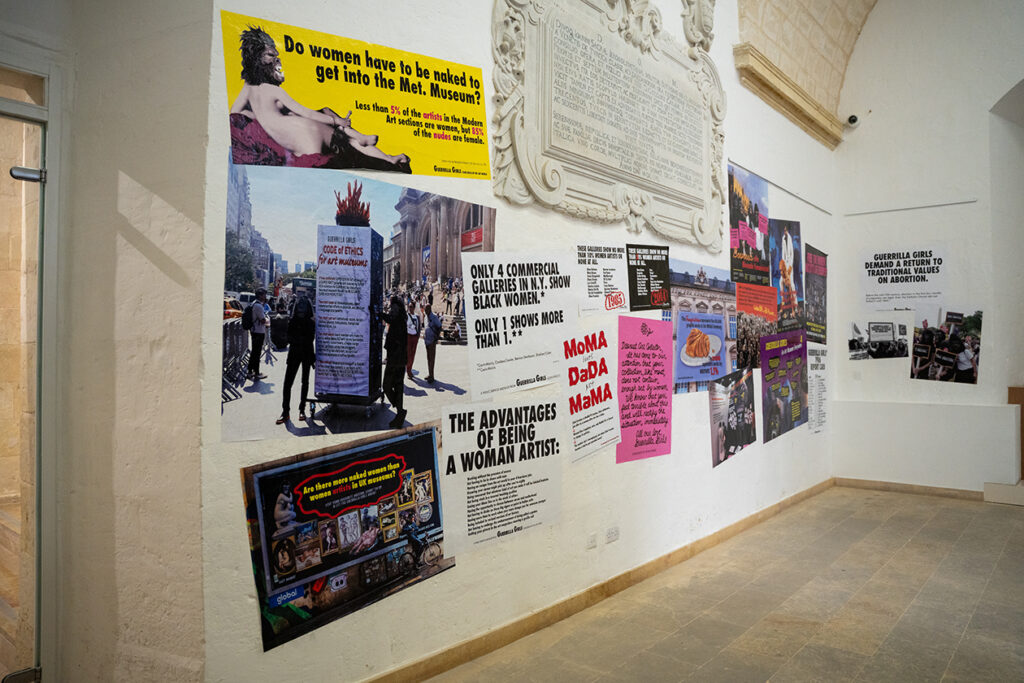
It’s a delicious irony that the illustrious 16th-century building that once housed the Knights Hospitallers is the chosen location for the Guerrilla Girls’ Malta Biennale showcase. Famed for calling out misogyny, racism and a host of other ‘isms’ within the arts world, the anonymous collective of female artists has turned MUŻA into a sharply political space of resistance with their work Laugh, Cry, Fight.
It’s a showcase that’s wonderfully fitting for the former Museum of Fine Arts, which now serves as Malta’s National Community Art Museum. The work speaks its intentions clearly, and even those who go in blind, with no inkling of what the Guerrilla Girls’ work stands for, will get it.
Rather than a single work, Laugh, Cry, Fight offers an overall introduction to the most prominent works of the collective from 1985 to 2024. The result is very much a walk through the most cutting statements, moving from left to right by theme and closing with a video selection of works.
As described by Frida Kahlo (members of the collective each take up the names of prominent women in the art world), it’s an explosion of the artists’ most prominent works.
“We wanted to make sure that people visiting the Malta Biennale are aware of the range of our work. The idea was to make it look like an explosion, so there’s overlap, works that are askew or floating across the room. It’s all intentional, and we made the most of the geometry of the space,” Frida says.
As the artist puts it, the Guerrilla Girls’ works are all “infinitely reproducible at many different scales”, which has certainly helped recreate them so effectively. Some of the works in the exhibition started out as street art, others as billboards. Placed all together, they tell a story.
“There are a lot of visual qualities like colour, composition, copy… But the works need to be taken together as a body of knowledge about the art world in the last 40 years,” the artist explains.

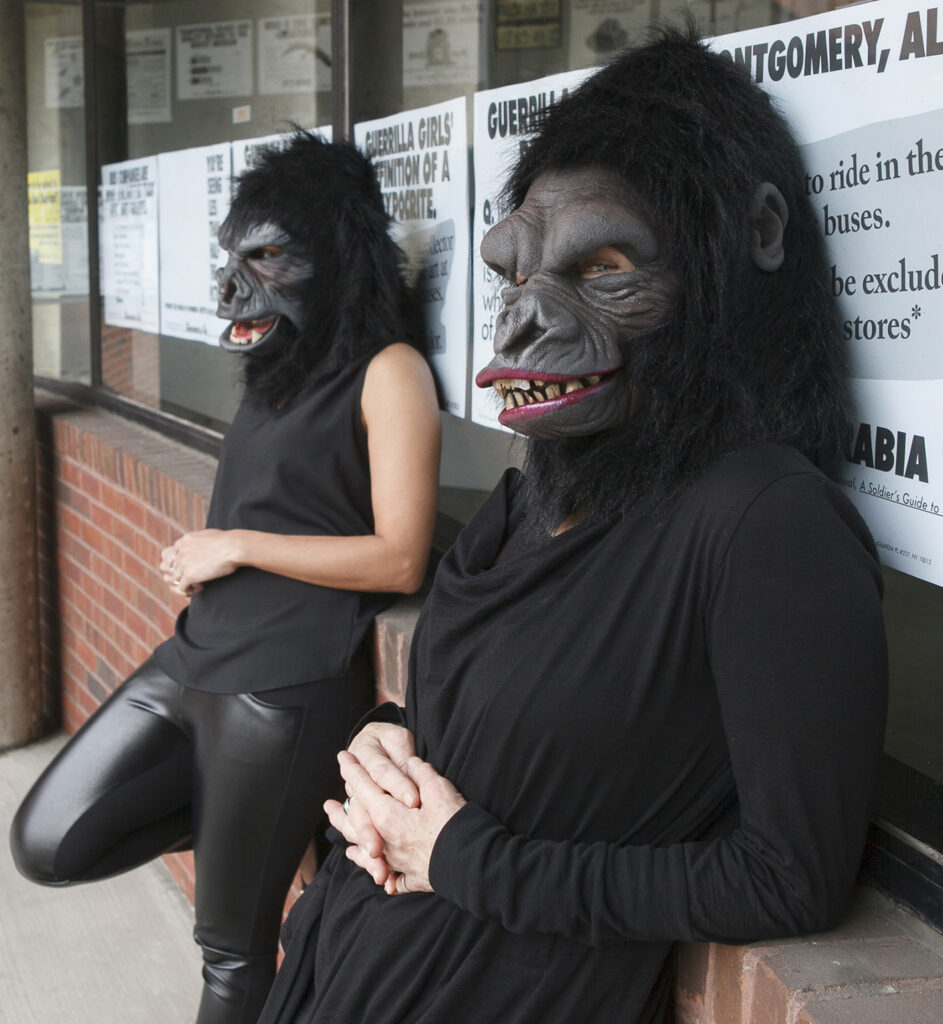
I ask her about her origins within the collective. Did she view this mainly as art, protest, activism, all three at once? The reply is simpler, and goes to the very root of the issues the collective seeks to tackle.
“To be honest, we were just angry. We were a very diverse group of different ages, stages of success, ethnicity… and we were all united around the idea that opportunities in the art world were not going to women and to people of colour. They mostly go to white men.
“Everyone seemed to be labouring under the belief that the world operates as a meritocracy. We wanted to put the facts to the public and allow people to reach their own conclusions,” she says.
The aim was to make people think about the issues they themselves were thinking about. To say they succeeded would be an understatement: the collective claimed public space, adopted media and advertising strategies, and “one thing led to another”.
The first street posters were created as a reaction to the overwhelming number of female nudes present in New York’s Metropolitan Museum of Art, and the way these nudes were invariably being “acted upon”. The posters called attention to this, with one pointed question: “Do women have to be naked to get into the Met. Museum?”

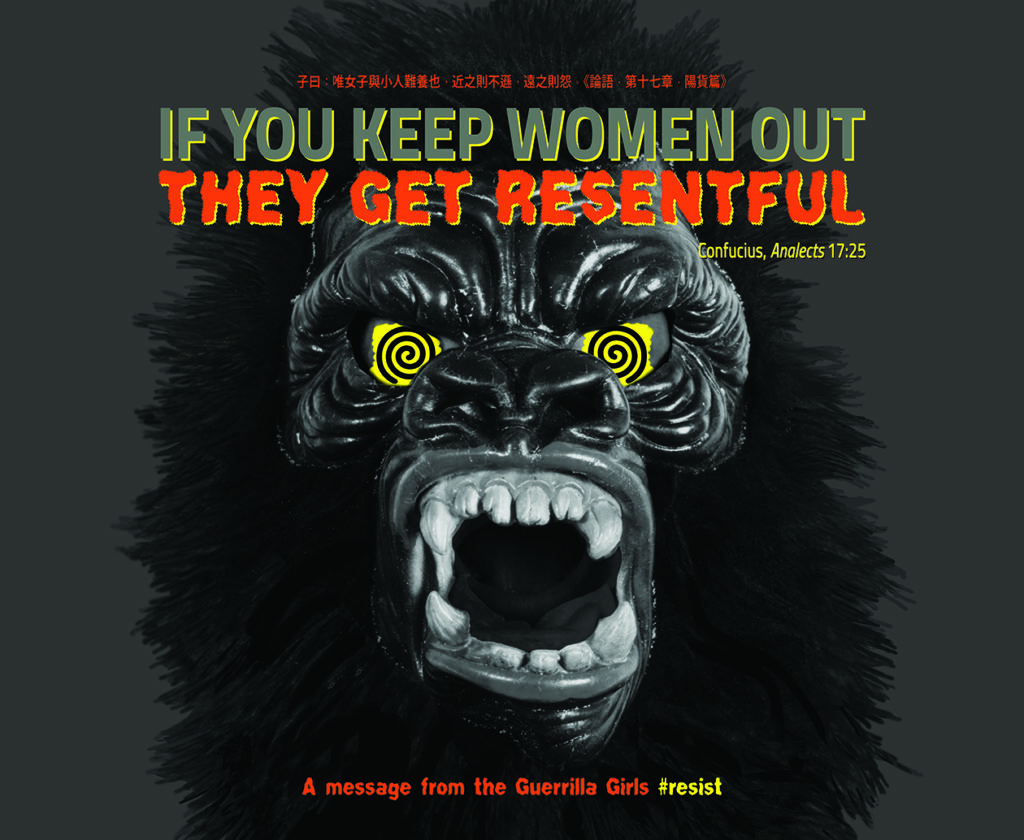
“They were enormously well-received, and we kept working on our message. First we went after male artists who allowed their work to be shown in places where women weren’t given an opportunity. Then we did the same with critics, museums and eventually even collectors.”
The latter, in particular, was a study in wry humour. Titled Dear Art Collector, it took the form of a “love letter of sorts”, in acknowledgement of the pivotal role collectors play in an artist’s career, it was handwritten and strewn with smileys. In a way, Frida says, it was the Guerrilla Girls’ acknowledgement that collectors make the market.
The main statement − “It has come to our attention that your collection, like most, does not contain enough art by women. We know you feel terrible about this and will rectify the situation immediately” − left the desired impact.
The collective’s renown has grown considerably since then, with the artists frequently invited to take part in institutional events precisely like the Malta Biennale. The list of locations they’ve exhibited at includes icons like the Tate Modern, the Museum of London and the Getty Center. The question begs itself: how do you avoid having their work neutralised by the very institutions it criticises?
“We have turned down opportunities because we felt that our values didn’t align”
“It isn’t easy, and this is something we think about all the time. We have turned down opportunities because we felt that our values didn’t align. But it needs to be pointed out that there are also well-intentioned people inside the institutions, people who believe in the value of a museum when recording culture. These tend to be the ones who are drawn to our work,” Frida replies, adding that the anonymity of the group also protects the work and the artist. She believes that it is this anonymity that allows them to be completely independent, and to not allow their work to be compromised.
And then there are the facts, of course. The Guerrilla Girls have this rather effective habit of propping up their statements with cold, hard statistics. They also source these statistics clearly, making it very hard to argue with what they’re saying. I close my interview with what I expect to be a run-of-the-mill question that circles back to statistics. Is there a question the art world still refuses to ask itself honestly? Frida’s reply is anything but run-of-the-mill.
“My big question is how investor Leon Black is still on the board of trustees at the Museum of Modern Art, given his very close relationship to Jeffrey Epstein. And many artists are still publishing with Phaidon Press, which is owned by him. We had an opportunity to publish with Phaidon in 2019, but we felt that the association would be a taint on the collective. We’d love to see artists who are successful take a difficult decision and say no, once in a while.”
It’s certainly a conclusion worthy of the Guerrilla Girls.
Laugh, Cry, Fight… With the Guerrilla Girls runs until May 29 at MUŻA, Merchants Street, Valletta. Tickets for all Malta Biennale events are available at maltabiennale.art.