

“I wandered out in the world for years / While you just stayed in your room / I saw the crescent / You saw the whole of the moon…”, sings Mike Scott of The Waterboys. The stanza captures something of the absurdity, unfairness, messiness and quiet resoluteness of the creative process.
Peter Shaffer’s Mozart – an inspired idiot-savant – stands in stark contrast to Salieri’s buttoned-up, manicured stolidity; one seemingly gifted the whole without method, the other condemned to method without transcendence. It begins to explain how a Rembrandt or a Zurbarán could achieve so much without ever straying far from their place of origin. Creativity, it seems, is not guaranteed by exposure alone.
Perhaps it is all in the head, or just as much in the arms, the legs, the ears, the eyes: in the body as a site of perception. Creativity may be understood as the byproduct of embodied experience; the manner in which one moves through life, making sense of space, rhythm and encounter through lived experience, rather than through preconceived maps or prescriptive methods.
Those memories and sensations tend to pool up in unexpected ways, woven into the very fabric of the work of art, both given by and giving shape to the creative process.
In this line of thinking, Gilles Deleuze famously turns the trope of the painter confronting the daunting emptiness of the white canvas on its head. There is never an empty canvas, he argues; it is already covered in clichés; pre-existing images, opinions and social conventions. The artist’s task is not to begin from nothing, but to meander within this pre-pictorial sludge, carving out a space for manoeuvre.
It sounds easier than it is. The clichés Deleuze describes are not so easily bypassed. Muscle memory and comfort zones can begin to delimit the artist, imprisoning thought rather than giving it wings. Mike Scott’s moon becomes obscured by clouds, denying even the consolation of the crescent.
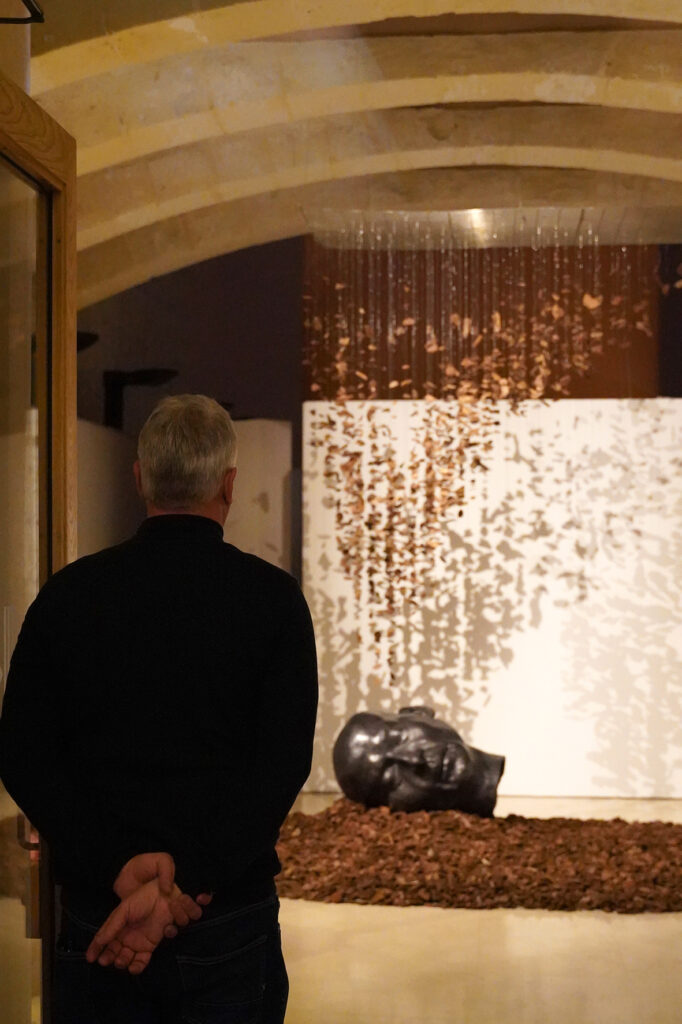
Paul Scerri’s installation Ma Nafx il-Vers li Ġej attempts to give shape to the creative process itself, turning upon itself in a self-referentiality not untypical of contemporary practice. It imagines the machinations of creativity groaning into motion: the doubt, exaltation, resistance, impasse and surprise that accompany the act of making.
The installation takes its title from a poem by the late Carmel Attard, who asks: “But the next verse – who knows what it will be?” It may carry within it suffering or joy, gravity or laughter; it may even be the poet’s final verse. The uncertainty of Attard’s lines is reflected in – and embodied by – the conceptual engine of Scerri’s work.
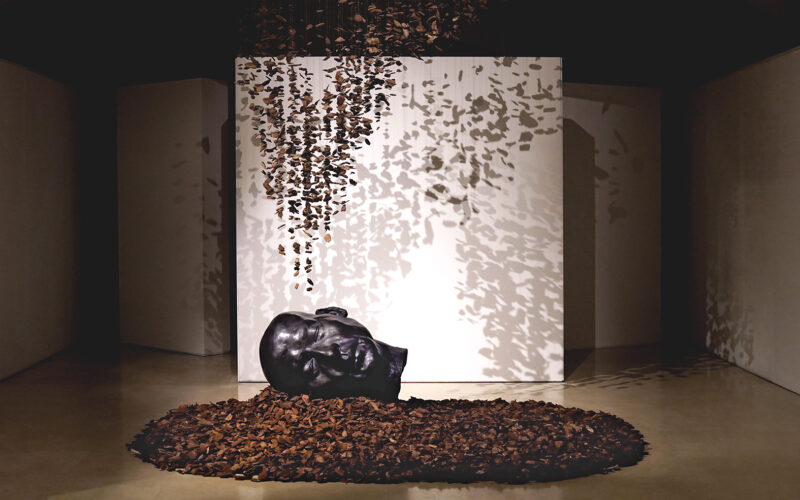
Suspended above a ceramic head, its eyes closed, are hundreds of fragments of tree bark or mulch, hung from lines of varying lengths. Mulch –abundant – creates a bed for the larger-than-life head. This is a site of dreaming and thought, of anxiety and incubation, recalling, at least metaphorically, Descartes’s pineal gland, where body and soul were believed to meet.
The fragments hover above the head like unrealised ideas: they promise much but may dissolve with time. And yet mulch is also fertiliser. Should it find soil, it may transform into humus, enriching the ground and enabling new growth.
Sol LeWitt’s Sentence 10 reads: ‘Ideas alone can be works of art; they are in a chain of development that may eventually find some form. All ideas need not be made physical.’ Scerri’s installation captures this state of liminality. It connotes a space where ideas are shaped, abandoned, resisted, lost, forgotten and transformed.
Scerri is an artist-ceramist, a master of his craft who has honed his skills to an almost obsessive degree of perfection. The manner in which clay and fire are harnessed has something alchemical about it. Transformed by fire, malleable clay hardens; further firings allow for the addition of glazes.
This may all appear rigorously process-based and precise – and it is – but at times craftsmanship may soar into something else entirely; transcendence earned through craft. It is the Mozart–Salieri analogy all over again. It does not always happen, and there are no perfect recipes, but when it does, it allows for sheer magic to take place.
Scerri’s many years of learning, working, experimenting, and teaching have occasionally afforded him the privilege of glimpsing more than the crescent. Ma Nafx il-Vers li Ġej may be, in part, about this as well. The head exists in a state of sleep, of dreaming; a liminal, uncanny condition in which one might, if only fleetingly, glimpse the whole of the moon.
Ma Nafx il-Vers li Ġej forms part of a series of four works commissioned by Spazju Kreattiv to mark its 25th anniversary. It could be viewed until March 15 inside Space B at St James Cavalier.
Satellite events
First event: Thursday, February 19 at 6.30pm. Artist Paul Scerri and Christian Attard will discuss key aspects of Scerri’s career and the thematic anchors that consistently underpin his work. The discussion will address questions of sense-making, viewers’ responses, Malteseness, materiality, formative influences and the dynamics of creative exploration and resistance. The event will last approximately an hour and a half, with the audience invited to actively engage, ask questions, and participate. This session will be conducted in Maltese.
Second event: March 7 at 11am. Artist Paul Scerri, author Paul P. Borg, and Christian Attard will discuss different angles of the creative process, including sources of influence, form and audience response. The discussion will take as its point of departure the title of Scerri’s installation Ma Nafx il-Vers li Ġej, a verse from a poem by the late Carmel Attard. Paul P. Borg, who was a close friend of Carmel Attard, has written the definitive biographical study about the poet: Maqful fil-ħabs ta’ ġbini. The event will last approximately an hour-and-a-half, with audience participation encouraged.