


At Palazzo Ferreria in Valletta, Josette Fenech’s latest exhibition, Where Hands Meet, unfolds as a meditation on thresholds, between abstraction and landscape, gesture and structure, surface and depth. The exhibition is curated in support of The Malta Trust Foundation for the Ta’ Saura Empowerment Hub, lending the works an added dimension of solidarity and social engagement.
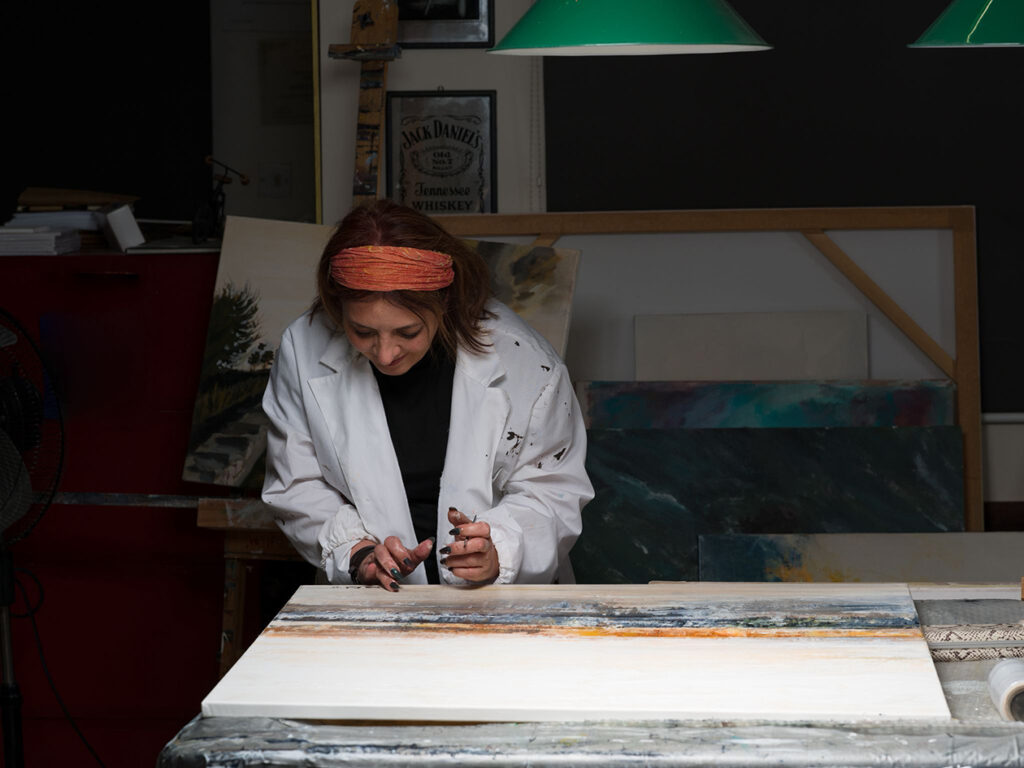
Fenech’s paintings, executed predominantly in mixed media, inhabit that evocative space where landscape dissolves into atmosphere and matter becomes emotion. They are not depictions of Malta’s terrain in any literal sense; rather, they are experiences of terrain, the geological, the emotional and the psychological.
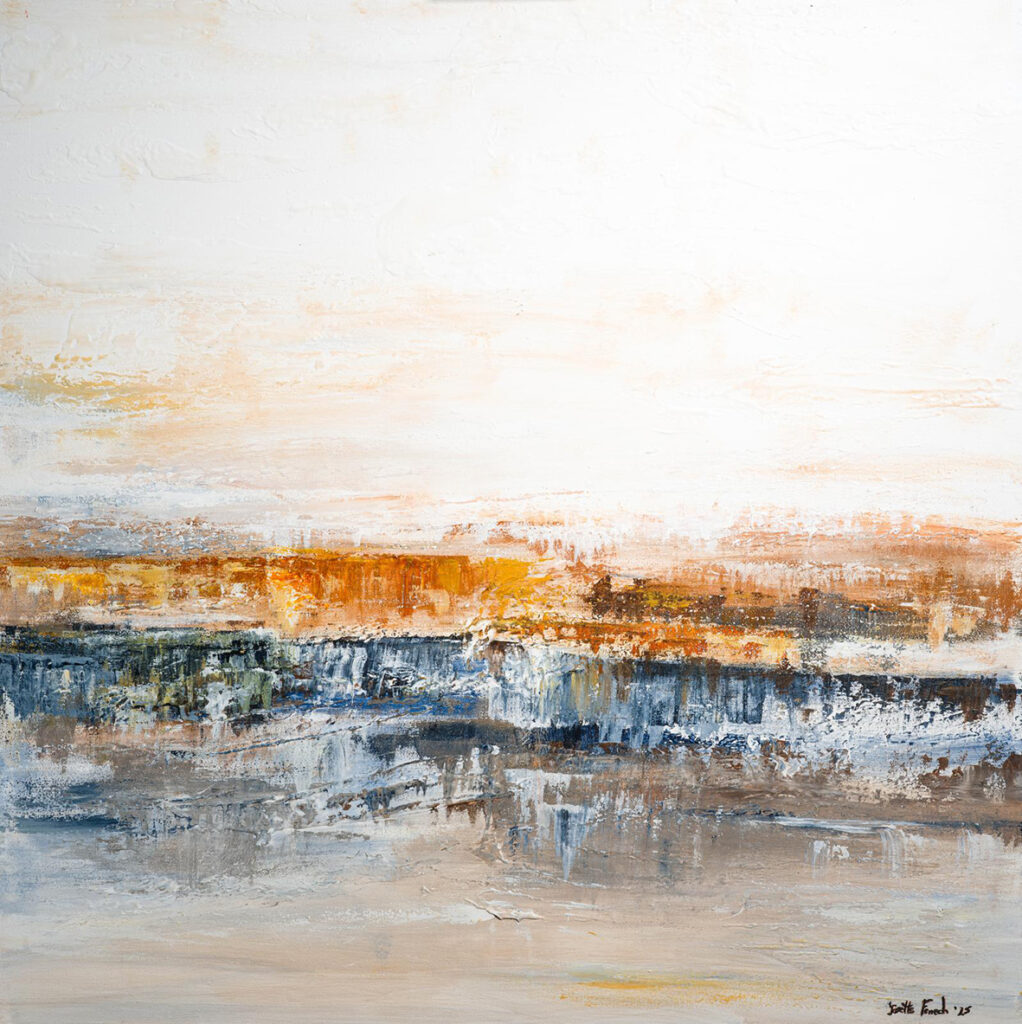
In works such as Before the Rising Sun, broad horizontal bands evoke a distant shoreline or escarpment. Ochres and burnt siennas hover above cooler greys and blues, suggesting a fragile equilibrium between warmth and shadow. The horizon is implied but never fixed. Paint is layered, scraped and allowed to bleed into itself. The surface carries the memory of its own making: accretions of pigment, abrasions and textured passages that recall weathered stone or eroded cliffs. One senses not a view but a process of emergence.
Similarly, Life in Between operates through a dynamic interplay of vertical and horizontal forces. Deep ultramarines and slate greys are interrupted by assertive fields of rust and orange. Architectural suggestions flicker briefly before dissolving into abstraction. The work occupies that compelling territory identified by art historian Simon Schama in Landscape and Memory (1995), where landscape is not merely topography but a repository of human experience and projection. Fenech’s surfaces seem to carry such psychic sediment.
The notion of abstraction poised on the verge of landscape finds a compelling contemporary, parallel in the work of German visual artist Gerhard Richter. His blurred seascapes and atmospheric abstractions destabilise perception, dissolving the certainty of the horizon while never entirely abandoning it. Richter’s technique of dragging and softening paint across the surface creates a tension between revelation and concealment. In Richter’s words: “I blur things to make everything equally important and equally unimportant.”
Fenech’s paintings achieve a similar suspension: nothing dominates, yet everything vibrates. In both artists, landscape is neither fully present nor entirely absent; it flickers at the edge of recognition. The viewer hovers between seeing a place and sensing a mood, between memory and material fact. Abstraction here does not erase landscape but transforms it into an interior terrain.
Her work may also be situated within what has been described as “abstract landscape”, a genre that acknowledges the persistence of nature as structure even when stripped of descriptive detail. As art critic Robert Rosenblum argued in his discussion of modern landscape painting, abstraction does not negate nature; rather, it internalises it. The landscape becomes a state of mind.
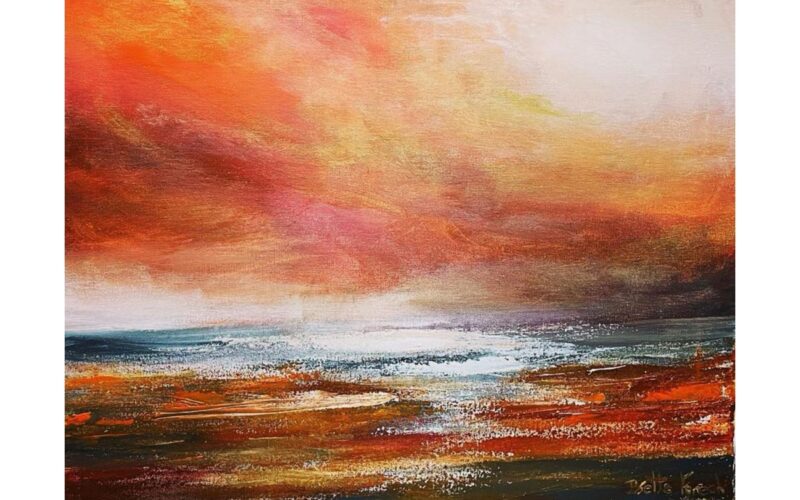
In Red Dawn, Fenech moves closer to chromatic intensity. A luminous expanse of crimson and vermilion spreads across the canvas, tempered by a distant band of cooler sea-green. The light appears to emanate from within the paint itself. Here, the horizon functions less as spatial marker and more as emotional axis. The work pulses with anticipation, dawn not merely as a meteorological event but as a metaphor for renewal.
“They are not depictions of Malta’s terrain in any literal sense; rather, they are experiences of terrain, the geological, the emotional and the psychological”
The exhibition’s title, Where Hands Meet, invites multiple readings. On one level, it gestures towards the physical act of making: the artist’s hands engaging with matter, building and eroding the surface. The tactile quality of the mixed media, the visible strokes, the dragged pigment, the sedimented layers all insists on material presence. On another level, the title suggests encounter: between artist and viewer, abstraction and recognition, art and community.
This latter dimension is reinforced by the exhibition’s philanthropic context. Curated in support of The Malta Trust Foundation for the Ta’ Saura Empowerment Hub, the show aligns aesthetic reflection with social purpose. The Ta’ Saura initiative focuses on empowering vulnerable individuals through education and skills development. In this light, Fenech’s layered surfaces may be read as metaphors for resilience, strata of experience built over time, scars transformed into structure.
Importantly, Fenech resists the temptation to overdetermine meaning. The paintings remain open, invitational. They ask the viewer to linger, to allow forms to surface gradually from apparent indeterminacy. This slowness feels particularly resonant within the bustling commercial environment of Palazzo Ferreria. Amid the rhythms of consumption and movement, the works offer a pause, a contemplative clearing.
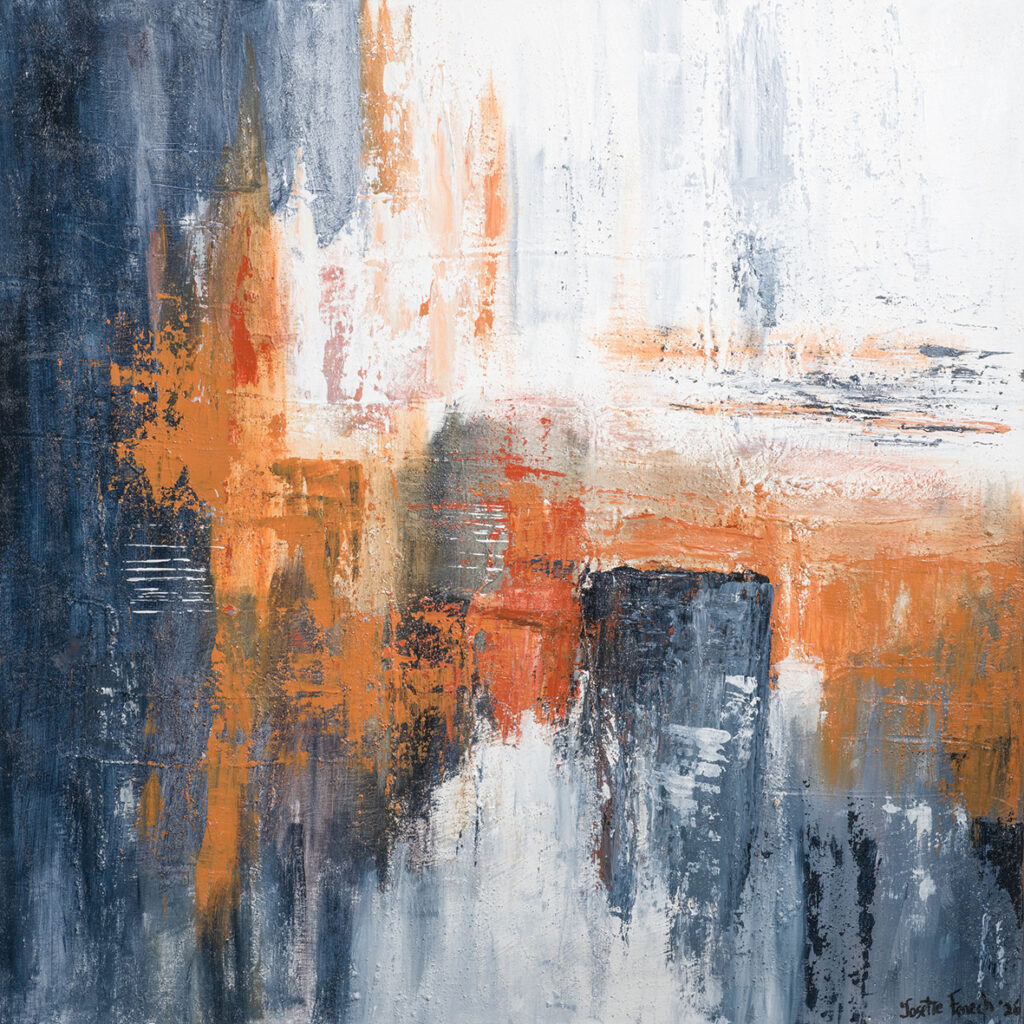
Abstraction at the edge of landscape carries a paradox: it distances us from the literal world while intensifying our awareness of it. In Fenech’s hands, paint becomes both terrain and emotion, both substance and light. The viewer oscillates between seeing a place and sensing a presence.
Ultimately, Where Hands Meet affirms the enduring vitality of painting. Through gesture, texture and colour, Fenech constructs spaces that are at once external and interior. They are landscapes of becoming – sites where matter and memory converge, and where the hand, meeting the canvas, leaves behind not an image of the world, but an imprint of lived experience.
Where Hands Meet runs at Palazzo Ferreria, Valletta, until April 5.