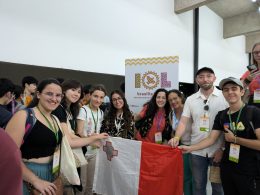






It starts with a beaver. Or rather, with 3,499 young people across Malta and Gozo, sitting in classrooms and computer labs, puzzling over brainteasers about beavers building dams, robots sorting letters, and hikers choosing the shortest trail through a forest. No coding required. No special software. Just 45 minutes of pure logical thinking − and, for most of the students taking part, a first encounter with a discipline they may not yet have a name for: computational thinking.
This is the Bebras Challenge, and Malta is now firmly on its map. In just two years, the island has gone from zero participation to nearly 3,500 students taking part, making it one of the fastest-growing newcomer countries in a competition that now spans 96 nations and reaches over four million young people worldwide.
Behind that rapid growth is a story of collaboration between a small but ambitious NGO, two university faculties, and a network of sponsors and partners who share a conviction: that computational thinking is not a niche skill for future programmers, but a foundational literacy for every child.
But what exactly is computational thinking? The term was popularised by Jeanette Wing in 2006, when the Columbia University computer scientist argued that it represented a universally applicable attitude and skill set, not just a concern for software engineers.
At its core, computational thinking involves four key practices: decomposition − breaking a complex problem into smaller, manageable parts; pattern recognition − spotting trends, regularities, and similarities; abstraction − filtering out irrelevant detail to focus on what matters; and algorithmic thinking − designing a step-by-step process to reach a solution.
People hear ‘computational’ and immediately think of computers, but computational thinking is really about how you approach problems. A doctor diagnosing a patient, a chef planning a complex menu, a lawyer building an argument − they’re all using these skills.
Consider a simple everyday example: a child is asked to organise a birthday party. Decomposition means breaking the task into food, invitations, games, and decorations. Pattern recognition means noticing that last year’s party worked well when games came before food. Abstraction means ignoring irrelevant details like what colour the napkins should be. And algorithmic thinking means putting it all into a sequence − first send invitations, then buy supplies, then set up, then welcome guests. No computer in sight, but the thinking is computational.
“Because computational thinking is not about turning every child into a programmer. It is about giving every child a mental toolkit that will serve them regardless of what they go on to do”
It is this broader vision that underpins everything Computational Thinking Malta − the NGO at the centre of the effort − has been doing since its founding. The NGO serves as a connective tissue between the academy, schools, government agencies, and industry sponsors. The most visible piece of the NGOs effort is the Bebras Challenge.
Founded in Lithuania in 2004 by Valentina Dagienė and named after the Lithuanian word for “beaver,” in honour of the animal’s industrious problem-solving nature, the challenge has grown into the world’s largest computational thinking competition for school-age students. Its genius lies in accessibility: questions are designed as playful logic puzzles that require no prior knowledge of programming, only curiosity and persistence. Students aged six to nineteen compete in six age categories, each receiving a set of easy, medium, and hard tasks to tackle within forty-five minutes.
Malta’s debut in 2024/25 attracted 2,825 participants from schools across the islands. By the second edition, which ran from October 2025 through February 2026, that number had climbed to 3,499 − a growth of nearly 24 per cent. The challenge is entirely free to enter, with teachers registering their students through the Bebras Malta platform.
The top three students in each category receive trophies at a dedicated award ceremony, while those placing fourth to seventh receive certificates of excellence. Every participant receives a certificate of participation and, crucially, access to a detailed answer-and-explanation booklet designed to turn the competition itself into a learning experience.
None of this would be possible without sponsorship. PwC Malta, as gold sponsor, provides vital financial backing and a clear signal that the private sector sees computational thinking as an investment in tomorrow’s talent pipeline. MDIA and the Melita Foundation serve as silver sponsors, with MDIA also providing institutional credibility and strategic alignment with national digital skills policy.
The team is also keen to acknowledge the support of the Directorate for Digital Literacy and Transversal Skills (DDLTS), which has been instrumental in helping to coordinate the Bebras Challenge across state schools — facilitating communication with educators and ensuring that the competition reaches students in every college across Malta and Gozo.
The impact of Bebras extends beyond the competition itself. With funding from an MDIA grassroots grant under the EU Code Week initiative, Computational Thinking Malta is producing a bilingual video series called Bebras Bytes, available on the organisation’s YouTube channel.
Each episode walks viewers through a Bebras-inspired computational thinking challenge step by step, in both English and Maltese. The videos are designed for use in the classroom and at home − giving teachers a ready-made resource to introduce or reinforce computational thinking concepts, and giving students a way to practise and explore at their own pace.
Perhaps the most strategically significant development, however, is taking place not in student workshops but in teacher education.
The University of Malta’s Faculty of Education has launched a Postgraduate Certificate in Computational Thinking and Coding for Primary Educators − a programme designed to equip classroom teachers with the confidence and competence to embed computational thinking across the curriculum. Sponsored by the Ministry of Education, Youth, Research and Innovation and offered exclusively to participants nominated by the Directorate for Digital Literacy and Transversal Skills (DDLTS), the programme is free to eligible educators.
This is a critical piece of the infrastructure. By training primary school teachers − the educators who shape children’s foundational learning habits − the programme aims to ensure that computational thinking becomes a thread woven through the fabric of Maltese education, not just a one-off event.
Why does any of this matter? Because computational thinking is not about turning every child into a programmer. It is about giving every child a mental toolkit that will serve them regardless of what they go on to do. In an age of artificial intelligence, algorithmic decision-making and data-driven systems, citizens who cannot think computationally are citizens who cannot fully understand the world they inhabit − let alone shape it.
Looking ahead, the ambitions are clear: more students taking Bebras, more teachers earning the Postgraduate Certificate, more Bebras Bytes episodes − and, eventually, the normalisation of computational thinking as a core component of Maltese education rather than an add-on.
For now, though, the most compelling evidence might be found not in statistics but in the classrooms where the challenge takes place. Picture a Year 4 student in a school somewhere on the island, staring at a puzzle about a beaver who needs to sort coloured logs into the right order. She furrows her brow. She tries one approach, then another. She crosses something out, starts again. And then − the click.
The answer falls into place. She grins and moves on to the next question. She might not know it yet, but she has just practised decomposition, pattern recognition and algorithmic thinking. She has just done computational thinking.
For more education-related articles, click here. For more Child stories, follow this link.