


During the solemn and contemplative days of Holy Week, the Sacred Heart Major Seminary in Victoria is hosting A Sacred Dialogue, an evocative joint exhibition by Maltese artists Christopher Saliba and Mario Sammut. The exhibition brings together painting and sculpture in a compelling encounter that transcends traditional religious representation, offering instead a deeply human meditation on suffering, belief and redemption.
At the heart of this exhibition lies a dialogue, not only between two artists working in different media, but between past and present, sacred narrative and contemporary experience.
Both Saliba and Sammut engage with themes that resonate profoundly within the liturgical context of Holy Week, yet their works avoid direct imitation of established iconographic traditions. Instead, they reinterpret the sacred through a modern sensibility that foregrounds psychological depth and symbolic resonance.
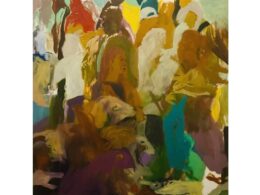
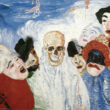
Saliba, primarily known for his painting, presents a series of works revisiting key moments from the life and Passion of Christ. His approach is neither illustrative nor devotional in the conventional sense. Rather, he distils biblical narratives into atmospheric compositions, where colour and gesture carry emotional and symbolic weight.
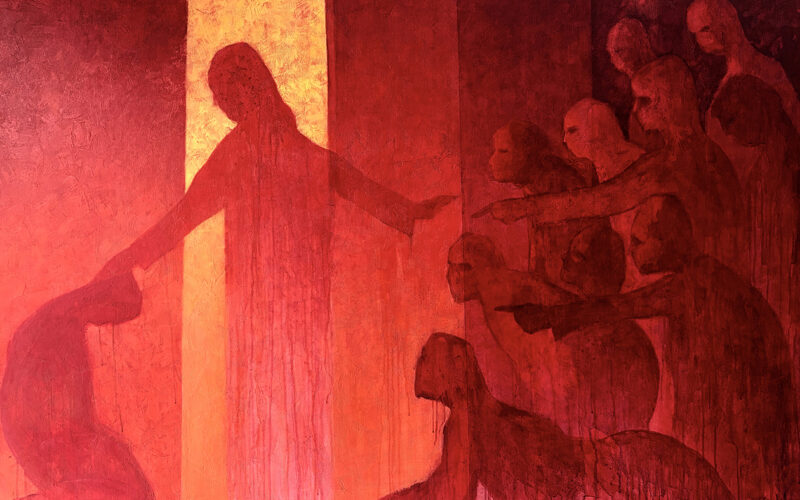
His palette, often marked by intense reds, luminous yellows and shadowed tonalities, creates a heightened sense of drama and introspection. The human figure, frequently elongated and partially dissolved into its surroundings, becomes a vehicle for expressing vulnerability, doubt and transcendence, appearing almost weightless as it fuses into near-abstract forms.
One of the most striking works in the exhibition is his interpretation of the Redeemer. Here, Christ is depicted not as a distant divine figure but as an intimate presence, gently placing his hand upon a supplicant seeking mercy. The composition eschews detailed realism in favour of a near-monochromatic field dominated by red, a colour that simultaneously expresses sacrifice, suffering and divine love.
The figures emerge and recede within this chromatic intensity, suggesting a space that is as much psychological as it is physical. Saliba’s painterly language, like Rothko’s ethereal abstract canvases, invites the viewer into a contemplative state, where the boundaries between the sacred and the human blur.
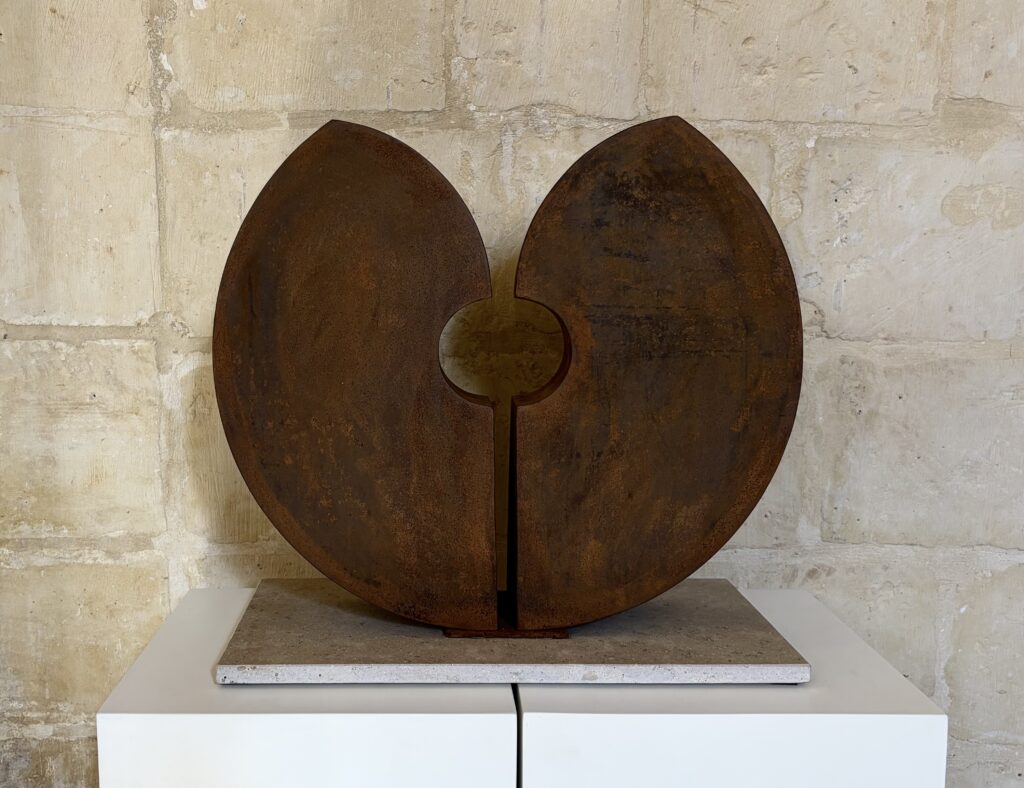
Saliba’s engagement with material extends beyond painting. In this joint exhibition, his expressive outlook is also found in his sculpture The Incredulity of St Thomas. Reduced to a minimal, abstract form, the sculpture features a central void, a symbolic reference to the wound in Christ’s side. This absence becomes a powerful presence, evoking both the physical reality of the Passion and the existential doubt of Thomas. The simplicity of the form belies its conceptual depth, offering a meditation on faith, touch and belief in an age marked by scepticism.
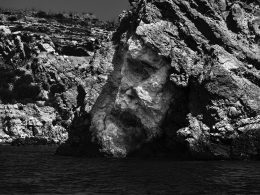
In contrast, yet in dialogue with Saliba’s contemplative works, Sammut’s ceramic sculptures present a more overtly communal and narrative dimension. Known for his elongated, robust figures, Sammut creates compositions that are at once stylised and deeply expressive, recalling in part the formal reduction and essentialised human presence found in the work of Constantin Brâncuși.
His figures, often grouped together, convey a sense of shared experience, of movement, struggle and endurance. Their simplified forms and textured surfaces evoke both timelessness and immediacy, situating them within a universal human condition.
A particularly compelling piece in the exhibition is a sculptural vessel resembling a crowded boat. At first glance, The Voyage recalls the precarious journeys of migrants crossing the Mediterranean in search of safety and dignity.
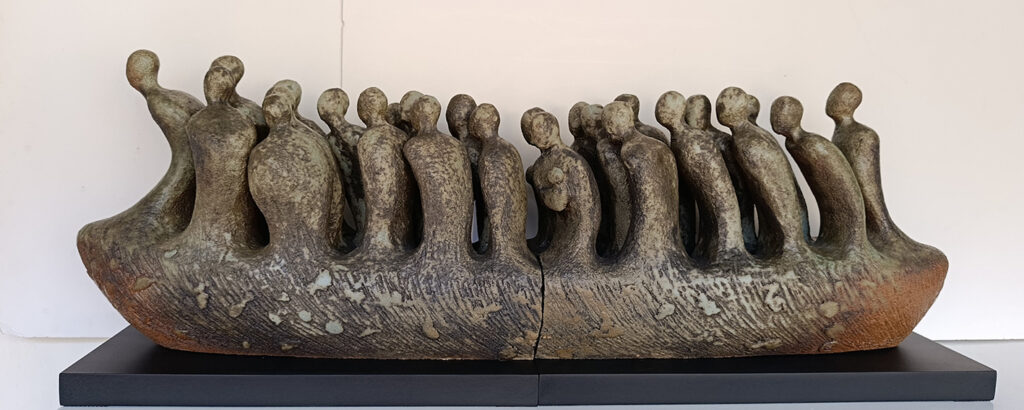
The tightly packed figures, leaning and pressing against one another embody both solidarity and vulnerability. This work resonates strongly within the contemporary sociopolitical landscape, where issues of displacement and migration continue to shape collective consciousness.
Yet Sammut’s sculpture also lends itself to a sacred interpretation. The boat may be seen as a metaphor for the Church or as a reference to Christ preaching from the waters, guiding his followers towards truth and compassion.
This duality, between the secular and the sacred, the immediate and the eternal, is central to Sammut’s artistic language. His work does not dictate meaning but rather opens a space for reflection, allowing viewers to navigate their own interpretations.
Another ceramic sculpture by Sammut, entitled Genocide, confronts the brutal realities of contemporary warfare and collective human suffering. The work exemplifies the artist’s characteristic formal language, in which a cluster of elongated figures is compacted into a near-spherical configuration, suggesting both unity and entrapment.
Their tightly bound arrangement evokes a sense of suffocation and inescapability, reflecting the indiscriminate nature of violence in modern conflict. Strikingly, the heads of the figures are marked with splashes of red glaze, a visceral allusion to blood that intensifies the emotional impact of the piece.
Within the context of Holy Week, this imagery acquires an added layer of meaning, recalling the Passion of Christ and the notion of collective sacrifice, where suffering is borne not only individually but as a shared human condition. The red markings resonate with the symbolism of Christ’s blood, transforming the sculpture into a meditation on martyrdom,
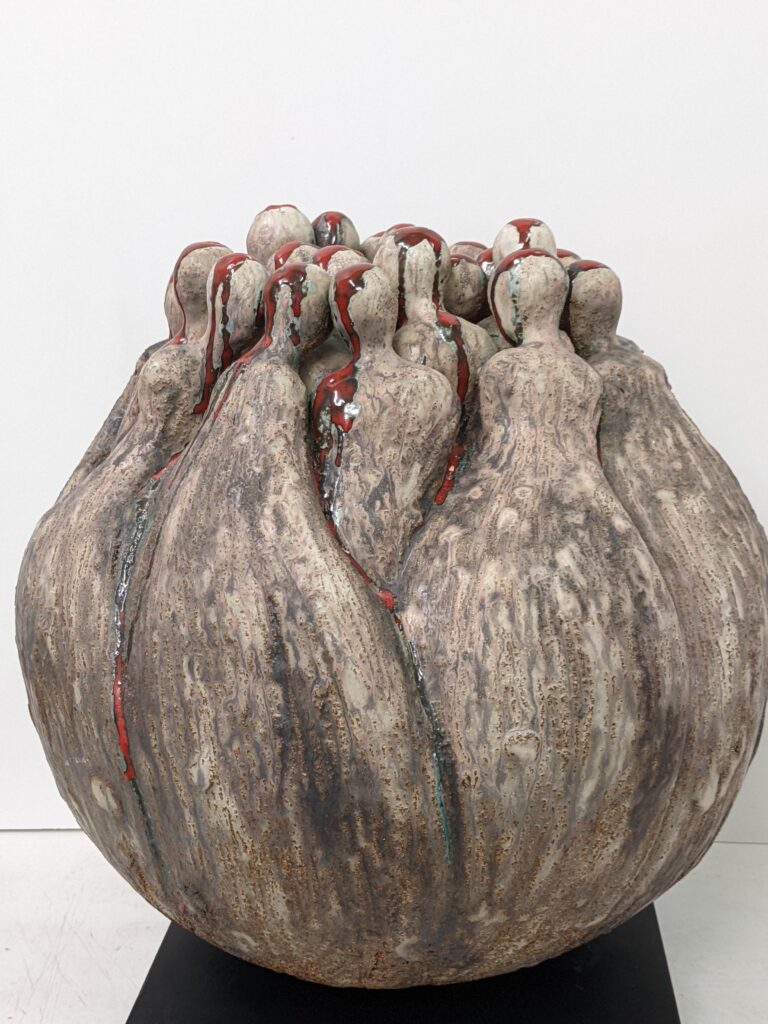
injustice and the enduring possibility of redemption. Through this synthesis of form and symbolism, Sammut elevates a contemporary political tragedy into a timeless reflection on human dignity, echoing the spiritual themes of suffering, compassion and hope central to the liturgical period.
What unites Saliba and Sammut is a shared commitment to exploring the human condition through a lens that is both personal and universal. Their works, though distinct in medium and style, converge in their capacity to evoke empathy and introspection. In the context of Holy Week, this convergence acquires a particular poignancy. The themes of suffering, doubt, sacrifice and redemption, so central to the Christian narrative, are here reimagined in ways that speak to contemporary realities.
A Sacred Dialogue thus becomes more than an exhibition; it is an invitation to engage with art as a space of encounter and reflection. Within the serene setting of the Sacred Heart Seminary, visitors are encouraged to pause, to contemplate and to enter into a dialogue, not only with the artworks but with the deeper questions they evoke.
In a time often characterised by noise and distraction, this exhibition offers a rare moment of stillness and depth. Through the interplay of painting and sculpture, of colour and form, Saliba and Sammut remind us that the sacred is not confined to tradition but continues to unfold within the complexities of the present.
A Sacred Dialogue is curated by Joseph Calleja and runs at the Sacred Heart Major Seminary in Victoria until April 12.