




Islands are as much places of resistance as they are cultural nodes of exchange. Perhaps the very islandness of Malta makes it an ideal geographical and conceptual space in which to think about identity, belonging and exchange.
These questions become even more pertinent on a small island whose many fragilities help define it; fragilities that range from ecological vulnerability and waves of migration to centuries of colonial domination.
Where and what is Malta? Who are its inhabitants, the so-called Maltese, who, despite their variegated and hybrid lineage, continue to embrace a form of stolid and arguably dubious nationalism conditioned by inherited narratives, a shared language that is at times denigrated, and the Catholic faith, which is becoming increasingly engulfed by secularisation?
As expected, art and literature have addressed such questions, sometimes directly but more often indirectly. Frequently − perhaps even heavy-handedly − they have done so through narratives of improbable patriotic heroism or through images which, like advertisements, reduce a complex reality to an assemblage of simple denoted meanings. One might think, for example, of Vassallo’s Il-Ġifen Tork or the Great Siege Monument by Sciortino.
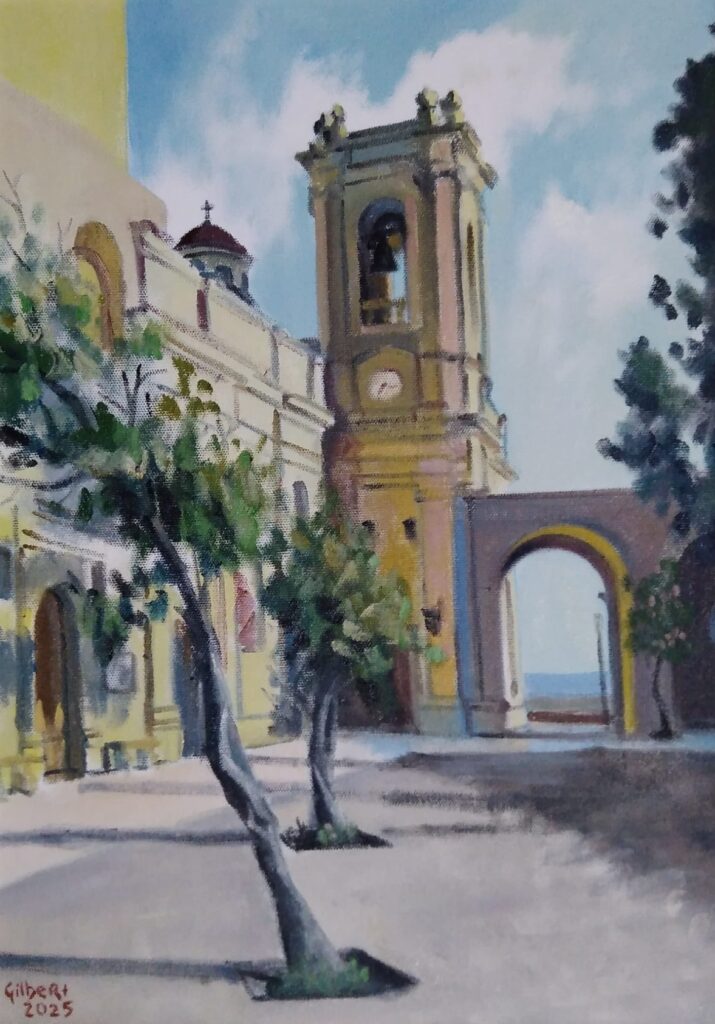
Like his artist father George (1926-2011), Gilbert Fenech (b. 1979) attempts to reach into Malta’s core in search of some form of authenticity. Yet, like his father, he does not pursue this through a sophisticated critical lens, but rather through a disarming, almost innocent gaze that perceives beauty in places or traditions that have somehow remained resistant to modernity.
“His images, consciously or not, play up Malta’s resilient islandness”
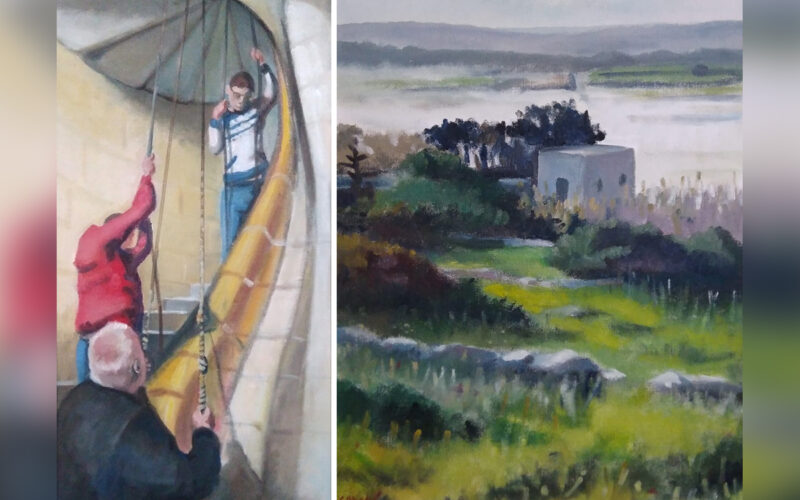
Two young boys, along with an older man, gather on a spindly spiral staircase, doing their utmost to pull the cords that toll the unseen bells within the belfry. This is not a declarative heroic gesture, nor a trope of machismo posturing.
Instead, it evokes a nostalgia that is almost graspable − a reminder of traditions that, even if not entirely extinguished, now seem to linger at the very margins of contemporary life, possibly considered not cool enough for the younger generation to embrace.
Elsewhere, images of rural trails lead viewers deep into a natural landscape where human presence is only hinted at by the odd field hut. Fenech’s still lifes similarly capture a rugged simplicity. This is a Malta that still exists, if inexorably fading away. Fenech wants somehow to capture it, to give it shape and form, reifying it with paint and canvas.
Fenech’s formal qualities are consonant with his imagery. His bold brushwork is typically straightforward, immediate and unmediated by intrusive stylisation, as if striving to remain faithful to the weathered forms it seeks to shape.
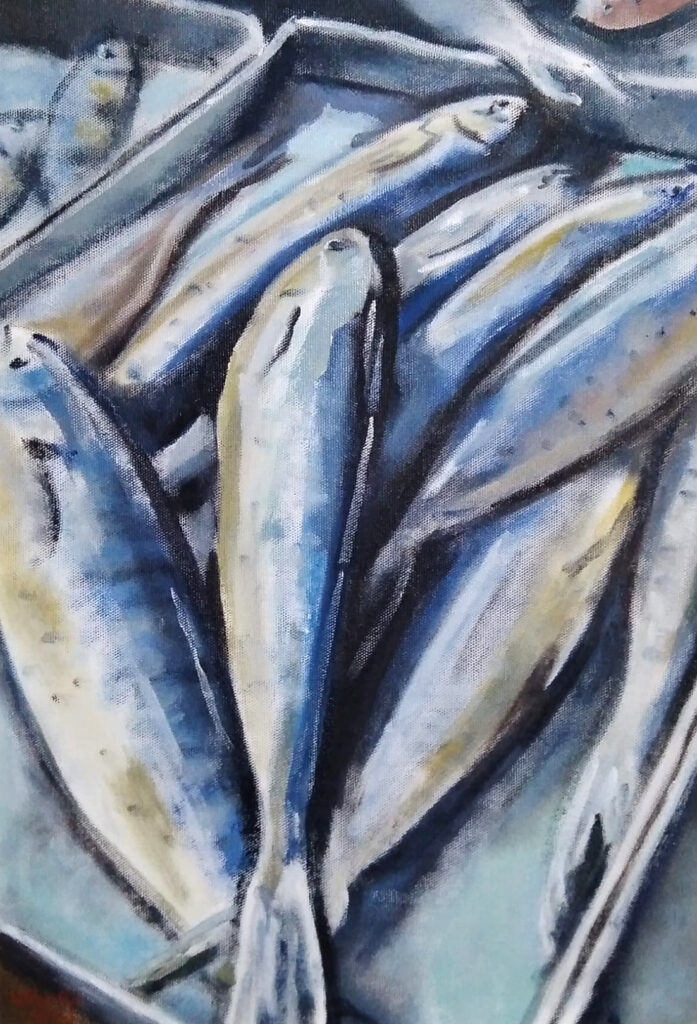
His images, consciously or not, play up Malta’s resilient islandness. They appear almost to have been born from the land that inspired them, like endemic organisms. The visual language they employ, even if distantly derived from late 19th-century modernism, retains something poetically insular about it − as if it had emerged from the rocks, crags and soil it seeks to depict.
Footpaths of Memory is ultimately another interesting exhibition taking place at the George Fenech Art Museum and Gallery, run by Doris, George’s single-minded, indefatigable widow. It has now become customary for this little museum to organise exhibitions away from the main museums and galleries, perhaps all the more interesting because of it, as if offering an alternative yet equally legitimate voice. And, like previous exhibitions, it honours the legacy of George Fenech, this time even more directly than ever.
This museum is like an island in itself, at times Deleuzian in its intensity. It dreams of pulling away, of introvertedly focusing only on George Fenech, yet it also forges beautiful connections that are as interesting as they are generative.
The exhibition runs at the George Fenech Museum, 42, Main Street Mellieħa, until June 20. Opening hours are Mondays, Wednesdays and Saturdays from 10am to 1pm; Fridays from 4 to 7pm.