





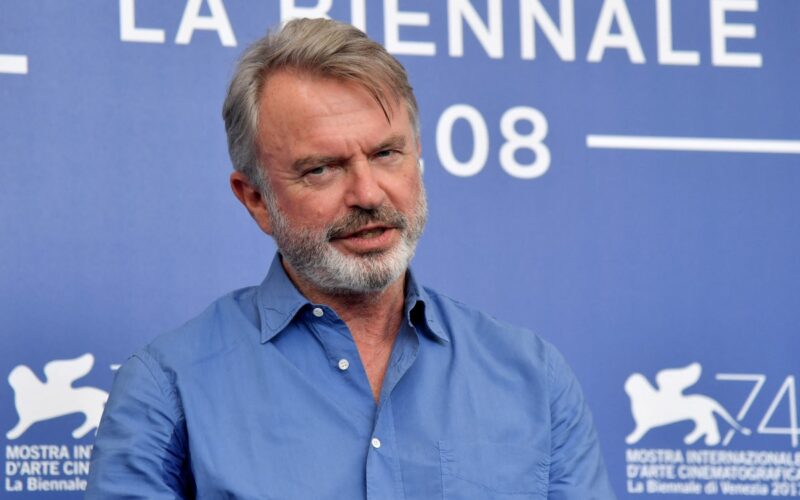
I remember watching an interview with actor Sam Neill, who died on Monday aged 78, saying “Good screen acting hints at secrets. At other lives underneath the veneer.”
At the time, I wondered what were these secrets Neill was referring to.
I just had to look at the vast body of Neill’s work, the characters he played, and how he played them to answer that question.
Claiming him as Australian
The actor was born Nigel John Dermot Neill in 1947 in Northern Ireland before moving to New Zealand as a child. In the time-honoured tradition of Australia claiming New Zealand talent as our own, it was when he made the move across the pond that he first found fame and the launching pad for his international career.
A law school dropout, he soon found acting to be his calling while at university, acting in a number of plays before moving to New Zealand television and his first starring role in the action thriller feature Sleeping Dogs (1977).
This film got him noticed in Australia where he picked up a small role in television series The Sullivans before landing his first major motion picture – My Brilliant Career (1979), opposite another emerging talent of the Australian screen, Judy Davis.
He made a plethora of less widely known films like Just Out of Reach (1979) and Attack Force Z (1982), while also appearing in television shows such as Young Ramsey.
His international breakout film was, unusually, playing the son of Satan in the quite schlocky Omen III: The Final Conflict (1981).
But the film was commercially successful, and the role opened up many doors for Neill who spent the rest of his professional career criss-crossing continents and acting in films and television series in the US, the UK, Europe and his original home, New Zealand.
As often happens with Australian talent, they have to be recognised overseas before they are recognised back home. So back in Australia we came to embrace Neill in landmark films such as playing Micheal Chamberlain opposite Meryl Streep in Evil Angels (1988) and opposite a young Nicole Kidman in Dead Calm (1989).
At this time, he met with producer Cubby Broccoli to be considered as the replacement for Roger Moore in the James Bond series, but unfortunately lost out to Timothy Dalton.
Neill may have been the greatest Bond we never had.
The actor who didn’t show he was acting
Perhaps the role he is best remembered for is as the star of the original Jurassic Park (1993) and sequels Jurassic Park III (2001) and Jurassic World Dominion (2022), where he played renowned palaeontologist Alan Grant.
This role is a great example of how refined his acting talents were.
At the beginning of Jurassic Park, Grant is quite aloof and cold to those around him, and visibly uncomfortable around the park owner’s grandchildren. As the drama unfolds, Grant gradually shifts to becoming the children’s protective mentor risking his life for them.
Neill doesn’t do this through dramatic speeches or over-the-top visual displays. Instead he gives us a performance of subtle shifts in the character’s behaviour.
Neill’s ability at nuance made his roles so believable and authentic.
When we view his body of work, we can see Neill’s characters always have a significant level of intellect and astuteness. He was often cast in roles of men of intelligence, quiet authority or class. Neill was the reasonable, decent man everyone looked at for stability and strength when disaster fell, and all others were losing their heads.
He had this understated quality to many of his roles. Not being the overt method actor like many of his generation, he chose restraint and reason, embellishing his characters with a feeling of genuine realism.
Neill was able to relate emotion through slight facial expressions or minute vocal inflections. He could be equally delighted, menacing or upset with just a glance.
The quality of the man
Neill took many risks with the roles he took on. His versatility and range meant he could be equally good in a historical drama (Sirens, 1994) as he was in a comedy (Death in Brunswick, 1990) or even horror (In the Mouth of Madness, 1994) and sci-fi (Event Horizon, 1997).
It shows the quality of the man that Neill was as willing to appear in blockbusters as he was in small, independent films, to help and coach the next generation of film-makers.
In ironic casting, the Sam Neill who dropped out of law school to become an actor played his final role as a lawyer, in the acclaimed three seasons of the Australian courtroom series The Twelve (2022–25).
In 2023, Neill said “I’m not afraid to die, but it would annoy me”.
For him it may have been annoying. Those who admired him will be meeting this moment with profound sadness and gratitude for the exceptional work he leaves behind.
Neill uncovered the secrets in the lives of all of his characters, presented them to us in his own inimitable style and made even the most ordinary moments feel quietly extraordinary.
This article is written by Daryl Sparkes, senior lecturer, media studies and production, University of Southern Queensland. It is being republished from The Converstation under a Creative Commons licence. Read the original article.