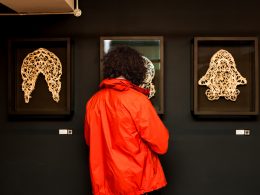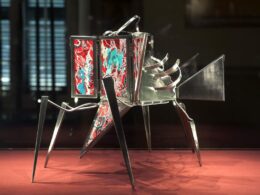



The current exhibition Vestiges by Silvio John Camilleri, held at the Wignacourt Museum, does not merely explore the notion of identity; it dismantles and reconstructs it through the medium of paint. At the heart of this body of work lies a sustained engagement with the self, not as a fixed or stable entity, but as a fluid and porous construct shaped by memory, instinct and imagination.
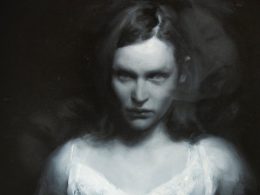
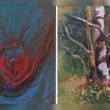
This becomes particularly evident when one considers the artist’s self-portraits in relation to the broader corpus of paintings in the exhibition. Unlike traditional portraiture, which seeks likeness or psychological depth through subtle observation, Camilleri’s self-images operate through distortion, exaggeration and fragmentation.
The face is not a stable surface but a site of transformation. Features are stretched, displaced or intensified, suggesting that identity itself is fluid, caught between inner impulse and outward expression.
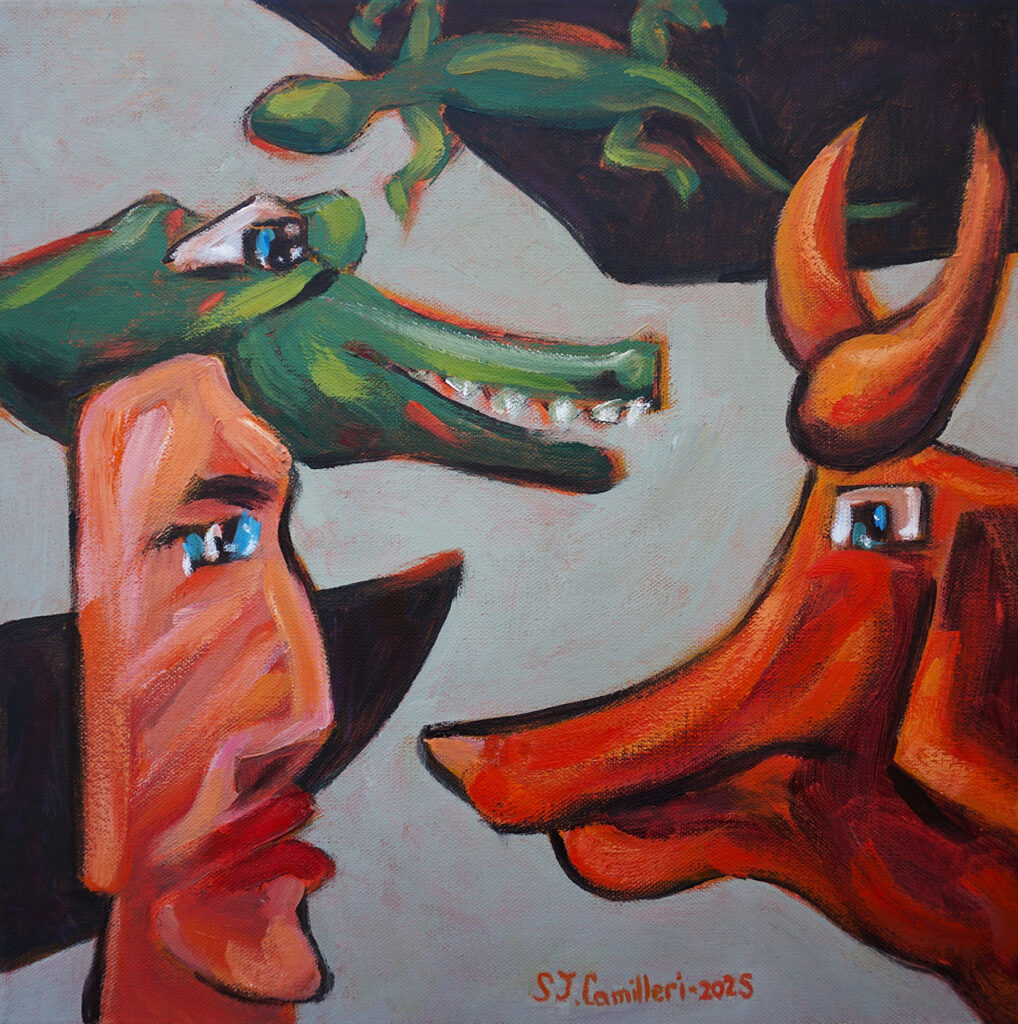
This approach situates Camilleri within a long and complex art historical lineage. One is reminded, for instance, of Francis Bacon, whose portraits dissolve the human face into zones of tension and sensation, or the Belarusian-born French painter Chaïm Soutine, for whom distortion becomes a means of conveying psychological unease.
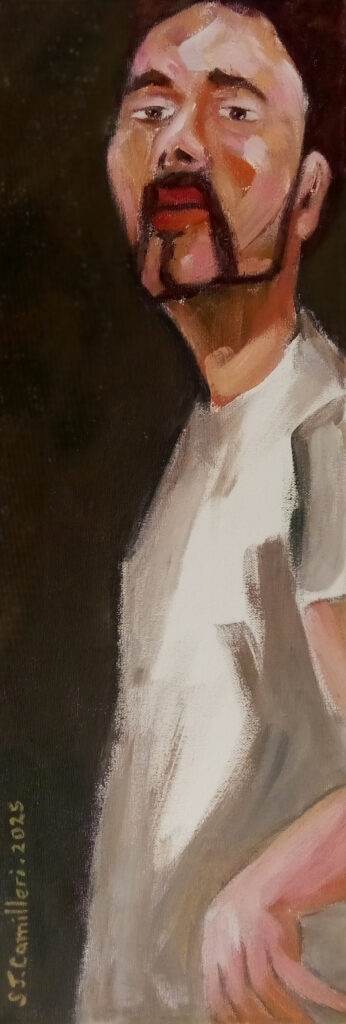
Yet Camilleri’s work does not dwell solely in existential anxiety. It also embraces a certain playfulness, a carnivalesque exaggeration that aligns with the grotesque tradition articulated by Mikhail Bakhtin, in which the body is open, excessive and constantly in flux.
As Bakhtin observes in Rabelais and His World (1965), “the grotesque body is not a closed, completed unit; it is unfinished, outgrows itself, transgresses its own limits.” In this regard, while Soutine’s early 20th-century expressionism is marked by visceral, emotionally charged canvases that bridge classical European traditions and modern abstraction, Camilleri extends such distortions into a more symbolic and imaginative realm, where the psychological merges with the mythic.
What is particularly striking is how this treatment of the self extends beyond the self-portrait into the wider imagery of the exhibition. The same formal language, bold brushwork, emphatic contours and a deliberate simplification of form reappears in compositions populated by hybrid beings, animals and symbolic elements.
In these works, human and animal identities merge seamlessly: lizards traverse bodies, eyes become exaggerated to the point of abstraction and mouths open into cavernous voids. The self is no longer contained within the individual figure; it is dispersed across a network of forms that echo and reflect one another.
This dispersal of identity suggests that Camilleri’s paintings are not only a reflection of his ‘self,’ but relational. The self is constructed through its connection to the natural world, to other beings and to a deeper, more instinctual layer of existence. In this sense, the recurring presence of animals, particularly the lizard, acquires a symbolic weight.
The lizard, often associated with regeneration and survival, becomes a mediator between worlds: between the conscious and the unconscious, the human and the non-human, the present and the primordial.
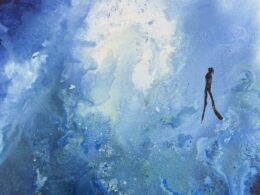
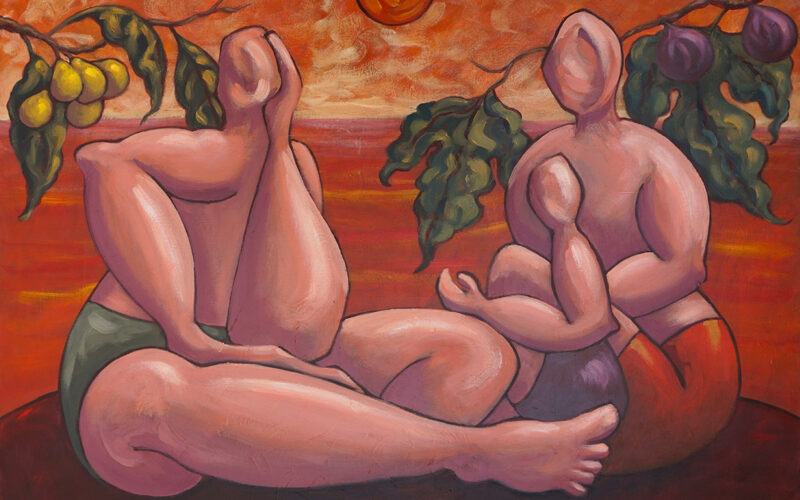
A similar logic governs the more figurative compositions within the exhibition, where simplified human forms inhabit sparse, almost timeless landscapes. These figures, often faceless or reduced to essential volumes, evoke a sense of universality. They are less individuals than archetypes, embodiments of states of being rather than specific identities. Their stillness contrasts with the more dynamic, hybrid imagery elsewhere, yet both modes are connected by an underlying concern with continuity and transformation.
“These figures, often faceless or reduced to essential volumes, evoke a sense of universality”
The primitivist impulse that runs through Camilleri’s work is crucial here. It manifests not as direct quotation from so-called “primitive” art, but as a stripping away of excess, a reduction of form to its most essential, symbolic components.
This impulse aligns his practice, in part, with artists such as Pablo Picasso and Wifredo Lam, who sought to revitalise modern painting through engagement with non-Western and archaic visual languages.
Yet in Camilleri’s case, this return to origins is deeply personal. It is less about stylistic influence and more about accessing a mode of image-making that feels immediate, instinctual and unmediated.
The psychological dimension of this process cannot be overstated. These paintings seem to emerge through a kind of internal dialogue, where images surface, collide and recombine in unexpected ways. There is a sense that the artist is not entirely in control of what appears on the canvas, that the act of painting becomes a means of discovery rather than execution.
This aligns his work, in spirit, with the surrealist exploration of the unconscious, yet without adhering to its formal doctrines. Instead, Camilleri develops a language that is uniquely his own: one that balances spontaneity with structure, intuition with compositional awareness.
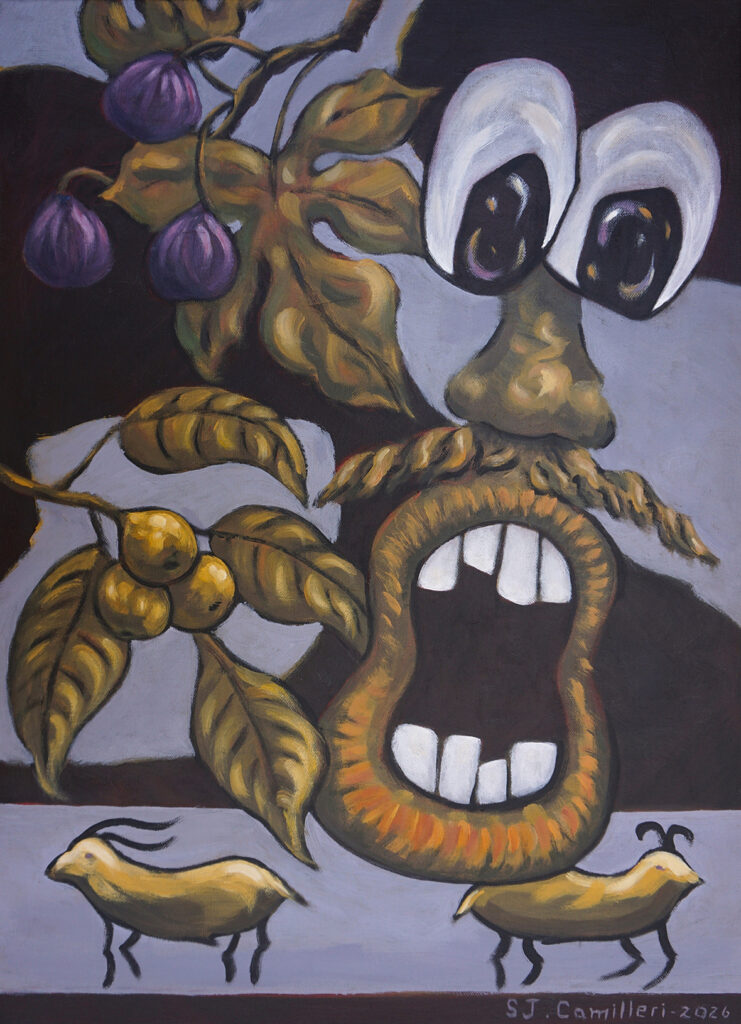
Colour plays a vital role in shaping this psychological space. Warm, saturated tones, particularly reds, oranges and earthy hues, dominate many of the compositions, creating an atmosphere that is both visceral and immersive. These colours do not simply describe; they evoke. They suggest heat, intensity and a kind of emotional immediacy that draws the viewer into the pictorial field.
At the same time, cooler tones are used strategically to create contrast and tension, reinforcing the dynamic interplay between different elements within the composition.
Ultimately, what Vestiges offers is a meditation on the nature of the self in relation to the world. By dissolving the boundaries between human and animal, interior and exterior, past and present, Camilleri proposes a vision of identity that is fundamentally interconnected. The self is not a fixed point, but a process, a continuous negotiation between different forces, both internal and external.
In the context of contemporary Maltese art, this approach is both distinctive and significant. It opens up a space for a more psychologically driven form of painting, one that engages not only with visual culture but with the deeper structures of thought and feeling that underpin it.
Through his bold, expressive language, Camilleri invites viewers to confront not just the images before them but the shifting, often elusive nature of their own inner worlds.
Vestiges runs at the Wignacourt Museum in Rabat until May 24.