


The landscape of contemporary Maltese art is frequently defined by its adherence to institutional lineage or deliberate postmodern detachment. However, the joint exhibition, titled Expressive Moods, by artists Tessie Borg and Joseph Borg, running until July 9 at Palazzo Ferreria, Valletta, promises to short-circuit these conventions.
What unifies these two distinct practices is not a shared formal technique, but a deeper adherence to what art theory categorises as ‘primitivism’: a deliberate turn towards unmediated emotional honesty, unburdened by rigid academic doctrine.
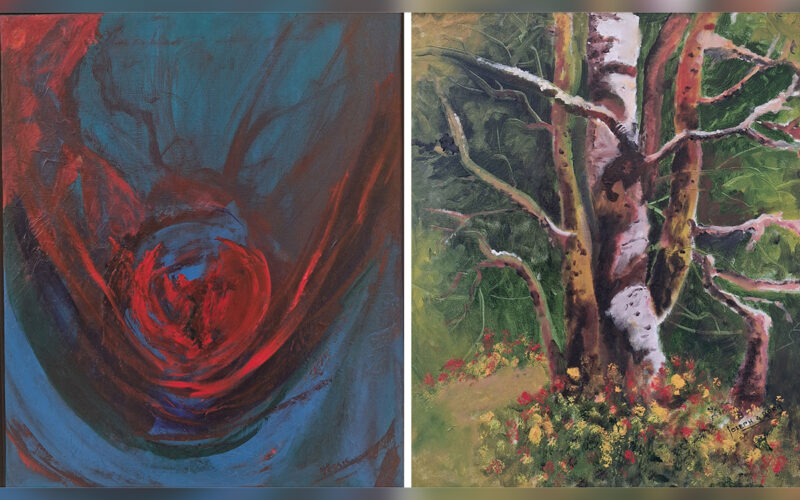
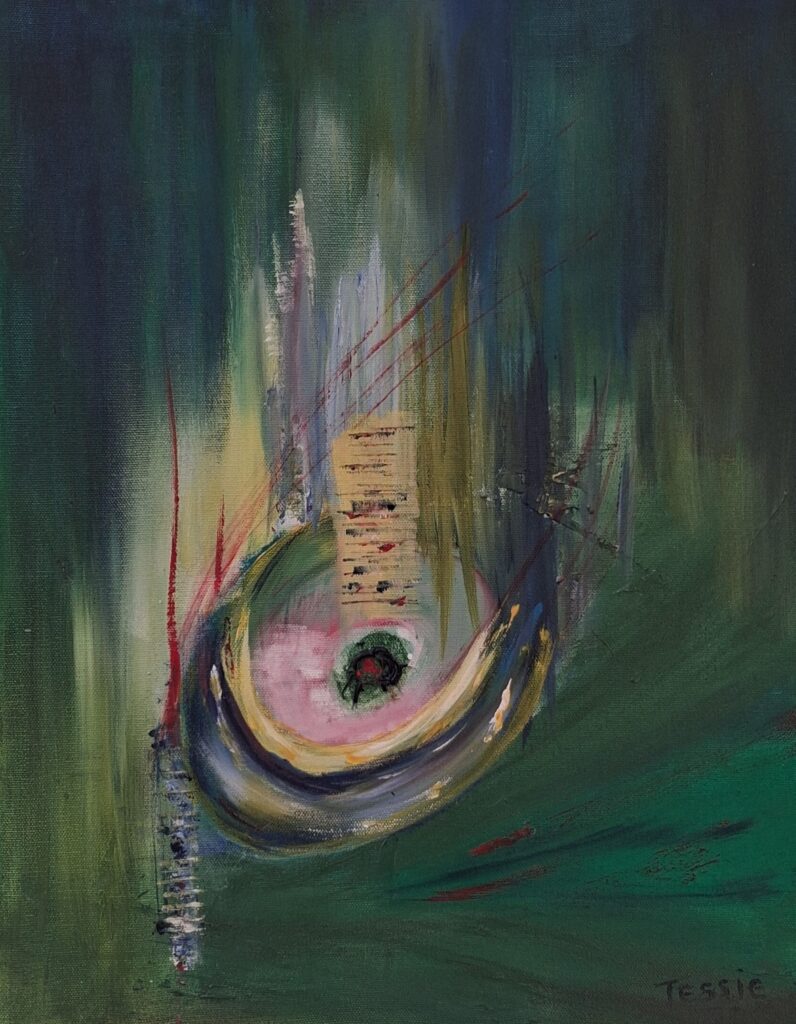
In the works of Tessie Borg, the trajectory bends decisively towards abstraction, yet it remains anchored in visceral human experience. Primitivism, in an abstract framework, manifests as an investigation of fundamental archetypes. Her canvas Reality subverts traditional architectural perspective, offering instead a swirling, vortex-like structure that cradles a central, embryonic dark iris. The scratchings of vertical and diagonal markings evoke a raw, musical scaffolding reminiscent of early modernist spiritual abstraction.
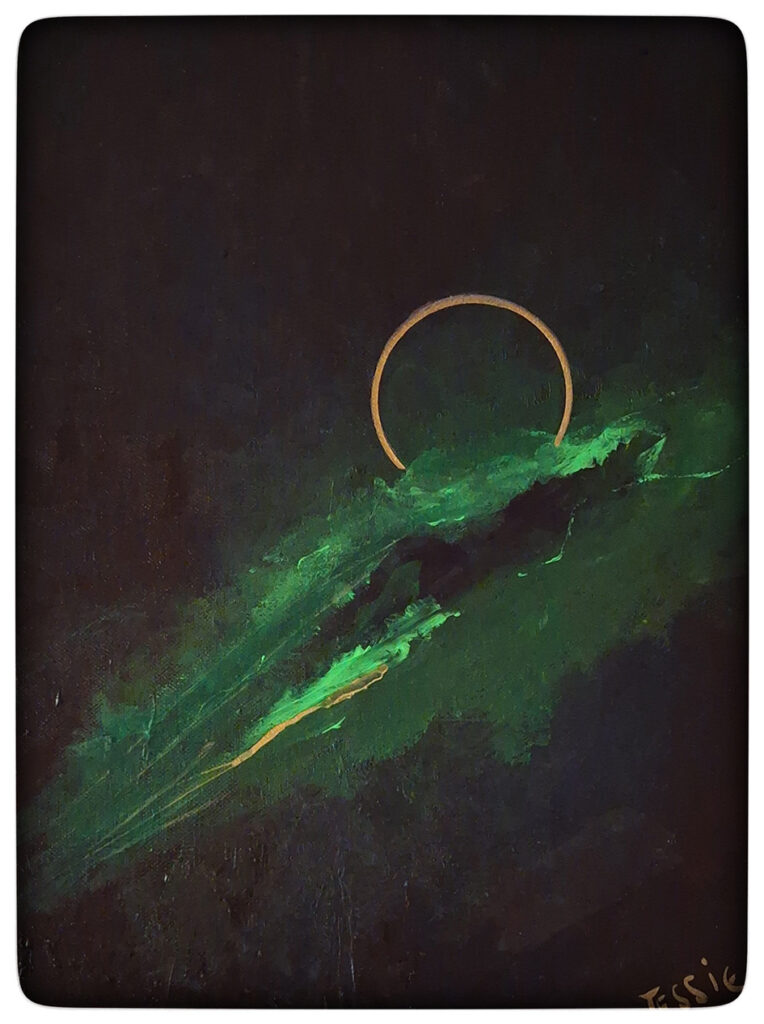
Tessie’s approach avoids sterile geometry. Instead, it mirrors the concept of the “primitive intuition”, the belief that the artist can tap into a deeper, pre-rational state of mind. This is profoundly evident in her stark piece Hope Dies Last, where a golden, fragile crescent hovers tentatively over a jagged, luminescent swath of emerald green, surrounded by a heavy, abyssal black. There is an untamed, cosmic simplicity here; the shapes operate as primal symbols of survival against engulfing darkness, bypassing intellectualisation to strike directly at the viewer’s subconscious.
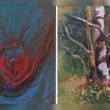
Even when addressing political or social anxieties, as in her tumultuous canvas Destroying Innocent Lives, the violent, circular gyre of crimson paint clashing against bruised blues channels an elemental fury. It exemplifies the primitivist theory of emotional necessity, where form is dictated strictly by the urgency of inner feeling.
Conversely, Joseph Borg anchors his vision in a recognisable reality, yet his approach is refreshingly far from academic realism. His landscapes and figurative renderings are fuelled by an organic, untutored sensibility that mirrors the ‘outsider’ branch of primitivism, where the world is observed with an intense, uncorrupted clarity.
In Joseph’s painting Tree Trunks, the natural world is stripped of idyllic, pastoral romance. The birch and bark are rendered with thick, tactile strokes, displaying an almost animistic quality as the branches twist outwards like grasping limbs. The foreground is alive with a riotous, unstructured carpet of red and yellow flora. By eschewing precise, academic botanical accuracy, Joseph captures the wild, uncontained energy of nature itself, reflecting a primitivist reverie where the environment is felt rather than merely documented.
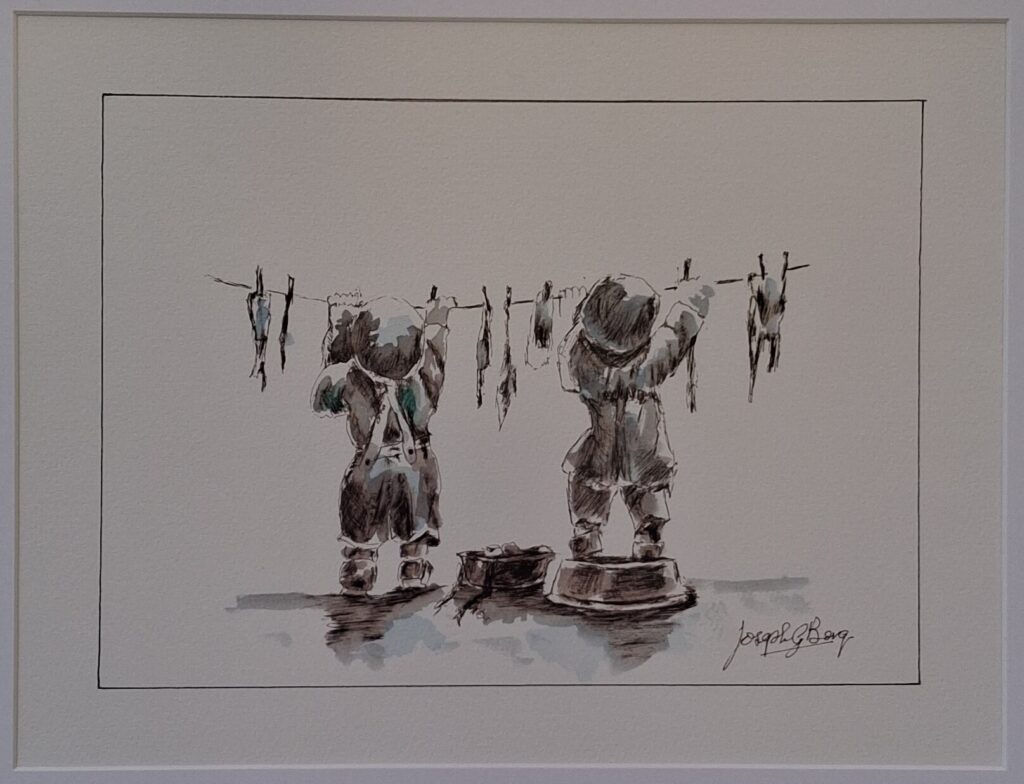
This untamed observational power carries over beautifully into his graphic works. His ink and wash drawing, Wash Day, captures a scene of domestic childhood innocence with minimalist, expressive linework. The figures of two toddlers hanging laundry are rendered with a stark, silhouetted economy of line that echoes early woodcuts or folk illustration.
There is no artificial sentimentality; the focus remains entirely on the heavy, grounded shapes of the children and the rhythmic line of garments. Joseph relies on structural honesty and unembellished truth, proving that realism needs no academic polish to be deeply moving.
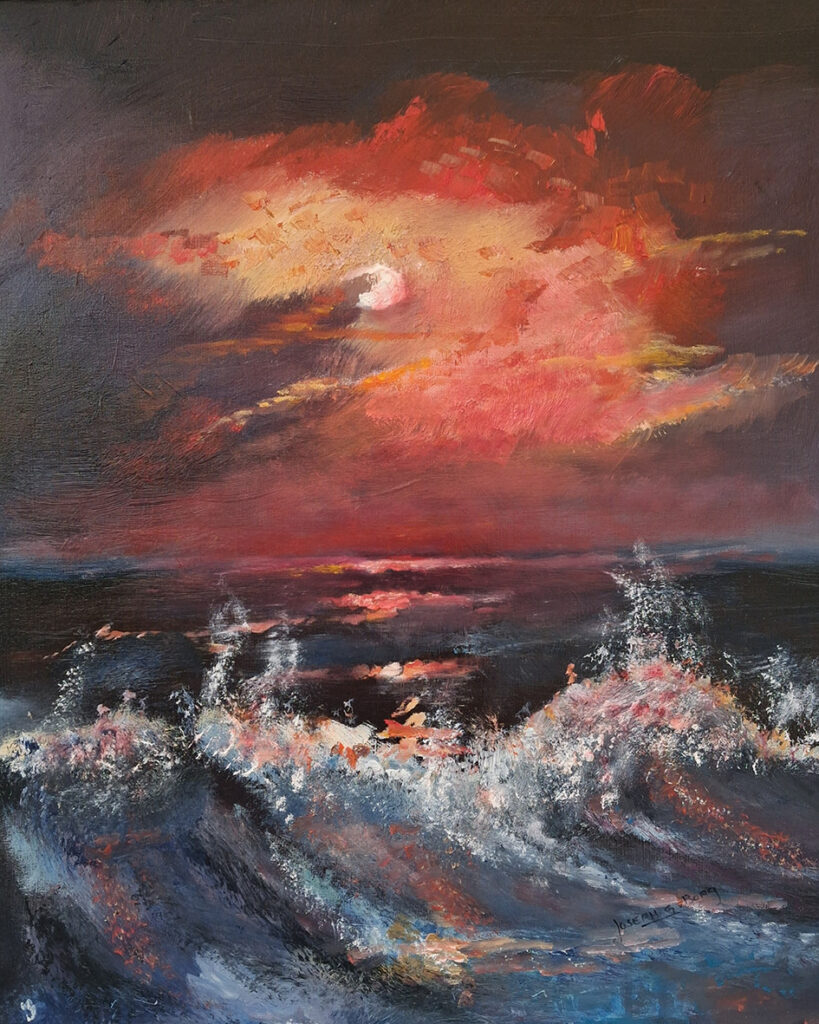
His sweeping marine canvas, Dusk, showcases a brilliant synthesis of his non-academic style. The sea is depicted not as a technical exercise in reflection, but as a churning, turbulent force. The frothing crests of the waves break in heavy, impasto whites and pinks under a bruised, fiery sky where the sun appears like a glowing ember. It is a triumphant display of expressionist bravura, capturing the sublime, primordial power of nature through an uninhibited, direct execution.
Ultimately, Expressive Moods functions as a vital reminder of what art can achieve when it detours from commercial trends and academic restrictions. By letting their respective practices be guided by instinctual feeling, whether through Tessie’s enigmatic, symbolic voids or Joseph’s rugged, immediate encounters with the physical world, the duo creates a dialogue that is both highly contrasting and singularly focused.
This collection does not merely present a series of visual experiments; it invites the viewer to strip back the layers of intellectual pretence and reconnect with the raw, elemental impulses of human expression.