



Across the history of Western sculpture, few motifs have been as endlessly reproduced as the crucifix.
In Malta, the Ta’ Ġieżu Crucifix in Valletta, sculpted around 1646 by Frate Innocenzo, epitomises the baroque approach: a dramatically realistic rendition designed to inspire devotion through theatrical immediacy. Yet, in the 20th century, as artists grappled with faith in an age of war, industrialisation and modern alienation, the crucifix underwent a radical reimagining.
What had long functioned as a stable iconographic form became a site of experimentation, as artists moved away from anatomical fidelity towards expressive, abstract and conceptual languages. In this context, the crucifix interpreted through a modern idiom is recontextualised away from the certitude of the baroque, destabilising its role as a fixed devotional image and repositioning it within a field of aesthetic and philosophical inquiry.
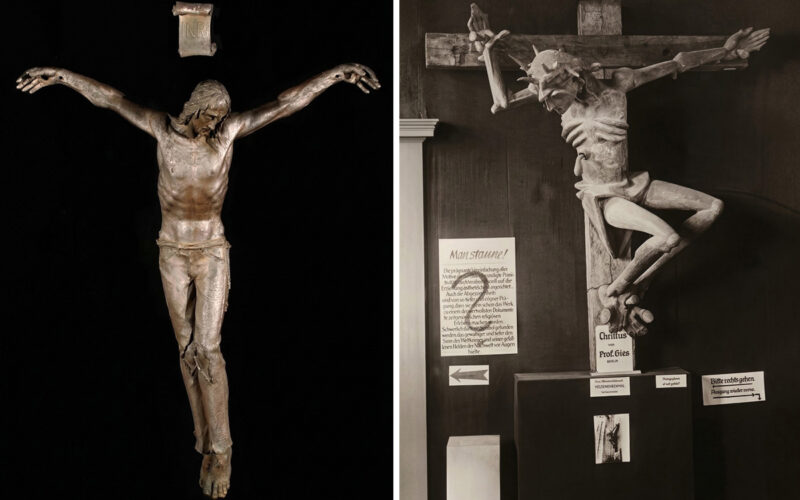
Ludwig Gies’s Crucifix (1921), originally created for Lübeck Cathedral, stands as a powerful example of German expressionism’s spiritual urgency. Carved in wood on a monumental scale, the figure of Christ is radically distorted, rejecting traditional devotional idealism. Its expressionist characteristics − marked by extreme bodily contortions − were so disturbing that the sculpture was vandalised by townspeople shortly after its installation, while critics condemned its grotesqueness.
This hostility culminated in its inclusion in the infamous Degenerate Art exhibition, where it was presented as evidence of the alleged corruption of modern art under the regime of Adolf Hitler. Yet it is precisely in this distortion that the work’s significance resides. The sculpture embodies a profound fusion of expressionist distortion and religious pathos, transforming the crucifix into an image of existential suffering that reflects Germany’s postwar disillusion.
Lucio Fontana’s Crocifissione (1955) foregrounds the crucifix as a site of material rupture rather than mimetic representation. Part of a long series of ceramic crosses executed between 1948 and 1961, the work reinterprets the crucifix through a distinctly abstract and spatially dynamic language rooted in what art critic Riccardo E. Ratti terms “subconscious baroque”.
This baroque dimension in Fontana’s work, however, is not to be understood as adherence to a historical style, but rather as an intuitive impulse which seeks to liberate form and colour from conventional compositional constraints.
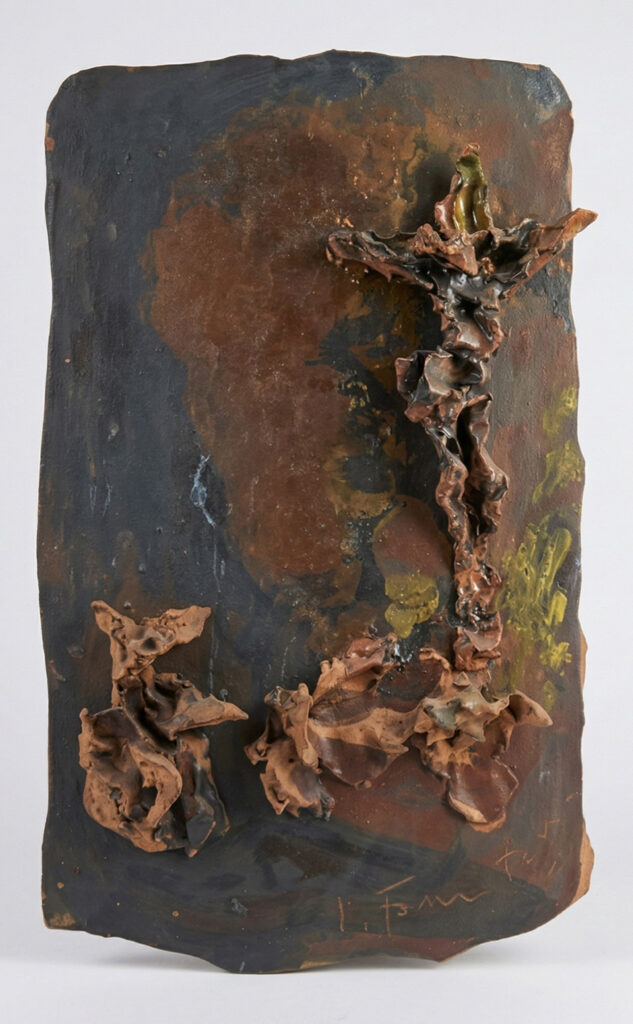
As articulated in his Manifesto Blanco (1946), the baroque’s capacity to project figures so that they appeared to leap out and continue their movements in actual space became, for Fontana, a point of departure for a radical exploration of spatial development that verged on the abstract.
The figure of Christ is thus reduced to gestural, almost violent interventions in matter, anticipating the logic of Fontana’s Concetti Spaziali. Here, the crucifixion is no longer an image to be contemplated but a cosmic event: the moment of death becomes a literal rupture of matter and space.
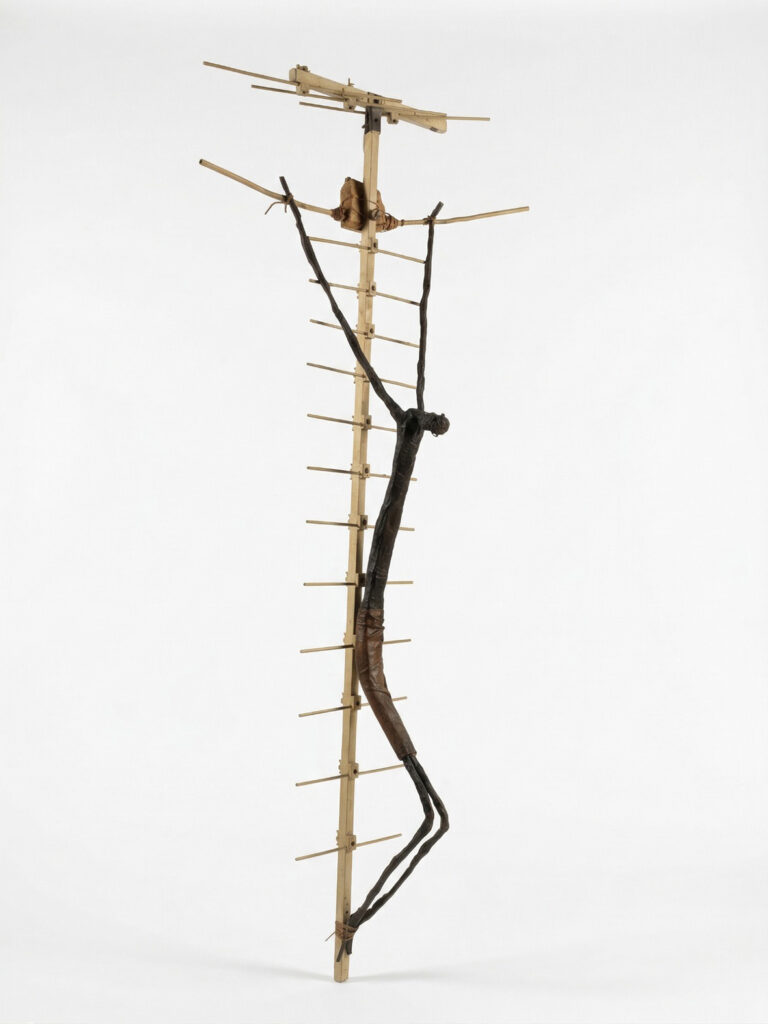
In Xandru l-Imħabba (1980s), Antoine Camilleri radically reconfigures the crucifixion through the language of objet trouvé and conceptual experimentation. The work replaces the traditional cross with a television aerial, from which a thin, elongated figure hangs with expressive intensity.
By incorporating a ubiquitous symbol of modern communication, Camilleri ingeniously transforms Christ’s sacrifice into an act of “broadcasting” divine love to a mass audience.
Furthermore, the use of repurposed, everyday materials aligns Camilleri’s practice with arte povera artists, who similarly transformed humble or discarded materials into artistic creations.
The television aerial in Xandru l-Imħabba thus participates in a lineage of modern art that elevates the mundane and challenges the idea that art has to be detached from everyday life. The work, therefore, marks a decisive shift in Maltese religious art, moving beyond baroque theatricality to reveal the sacred within the everyday realities of contemporary life.
In contrast to these more radical reconfigurations, Anton Agius pursued a path shaped by a tension between modern art and tradition. Although trained in experimental, abstract styles, Agius remained reluctant to move too far from forms that audiences could easily recognise.
His Crucifix (1983) reflects this approach. It retains a recognisable figure of Christ, grounded in traditional craftsmanship, yet introduces a subtle but potent contemporary intervention: Christ is dressed in jeans.
As noted during its unveiling at De La Salle College, this gesture sought to render Christ more immediate to younger audiences by introducing the sacred within the visual codes of everyday modern life.
In Kurċifiss (2024), Egeo Baldacchino interprets the crucifix in the visual language of expressionism and Fauvism, utilising distortion and colour as primary vehicles of meaning. His Christ exhibits violent chromatic contrasts, a sculptural transposition of the bold, vibrant colours that defined Fauvism during the early 20th century.
In line with expressionist principles, Baldacchino abandons photographic verisimilitude, privileging instead a higher, non-naturalistic truth that renders visible the inner psychological and spiritual condition of the subject.
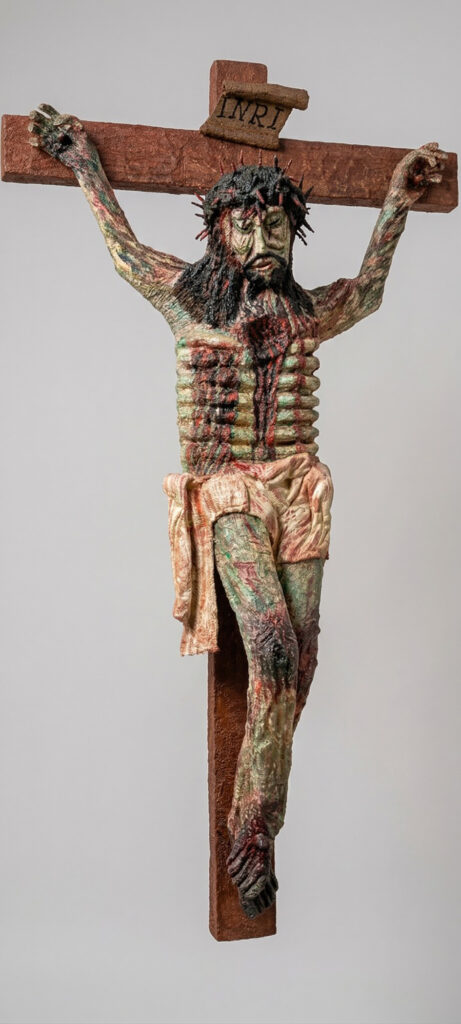
As Henri Matisse famously asserted, “l’exactitude n’est pas la vérité” (accuracy is not truth), a premise that Baldacchino’s work fully embraces. In this sense, Baldacchino’s expressionist-fauvist Christ thus aligns with the broader modernist conviction that art’s distortions can speak greater truth than imitation.
These five crucifixes collectively demonstrate how modern artists transformed a devotional image through the languages of 20th-century art.
By embracing distortion, abstraction, unconventional materials and expressive colour, they moved beyond baroque theatricality towards a continual reinvention of the symbol of sacrifice, in keeping with the demands of the new spirit.
Rowna Baldacchino is an art historian and cultural critic with postgraduate specialisation in art history, literature and translation, focusing on modern and contemporary art in Malta.