



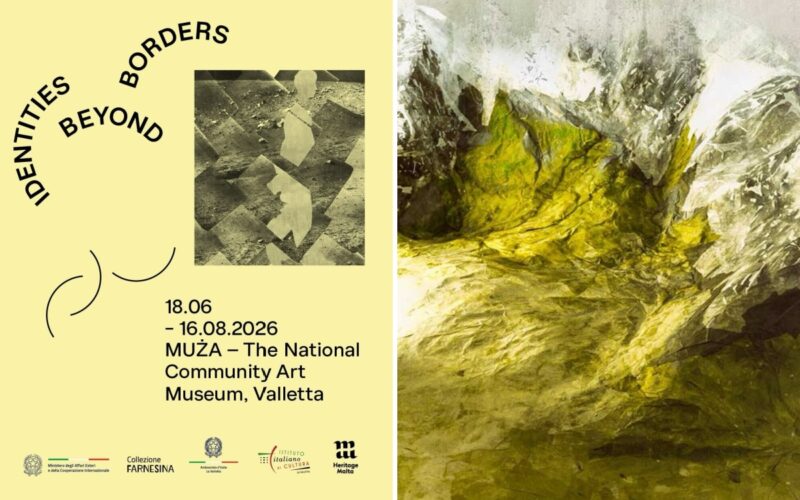
An exhibition that has been travelling around Europe is opening this evening at MUŻA − The National Community Art Museum.
Curated by Benedetta Carpi De Resmini, Identities Beyond Borders is promoted by the Italian Ministry of Foreign Affairs and International Cooperation on the occasion of the 25th anniversary of the Farnesina Collection. The initiative offers a broad and layered reflection on the concept of identity in the contemporary world, shaped by ecological crises, migratory phenomena, geopolitical instability and profound cultural fractures.
Originally conceived as a three-stop travelling exhibition, the project has gradually expanded and following its Paris chapter, the exhibition is now in Valletta, a key site within Southern Europe. The region has long been on the front line of issues related to climate change and migration, and Malta, due to its geographical and cultural position, becomes a focal point where these challenges acquire deep cultural significance.
The exhibition journey begins with Fibonacci by Mario Merz, a metaphor for an organic, non-hierarchical form of knowledge that expands through connections and branching paths. The display unfolds through three thematic sections − Roots of Resistance, Unstable Ecologies and Geographies of Detachment − each addressing the tensions of the contemporary world from radical and diverse perspectives.
In Roots of Resistance, works by leading figures of the female avant-garde, including Tomaso Binga, Carla Accardi, Ketty La Rocca, Maria Lai and Elisa Montessori, enter into dialogue with works by Elena Bellantoni, Silvia Giambrone, Marinella Senatore and Loredana Di Lillo. Here, subversion emerges as a living practice in which body and language become tools of emancipation.
Geographies of Detachment explores rupture as a lived experience. The works of Gea Casolaro, Agnese Purgatorio and Sarah Ciracì trace maps of urban, social and emotional wounds. Meanwhile, the works of Ra di Martino, Marta Roberti and Paola Gandolfi depict figures suspended between the human and the non-human, liminal presences that question identity as a process of constant becoming.
In Unstable Ecologies, the works of Letizia Battaglia, Silvia Camporesi, Martina Della Valle, Iginio De Luca, Elena Mazzi and Laura Pugno position the landscape as the central protagonist: a vulnerable organism in crisis, yet open to possible forms of regeneration, inviting reflection on the need to imagine new modes of coexistence.
As in the previous chapters of the project, the Maltese edition includes site-specific interventions and a selection of additional works designed to deepen the dialogue with its host context. The poem selected for this chapter by Tomaso Binga is Rima di Mari (2002), which explores the presence of the sea, its intensity and its role as a space of transit and identity redefinition.
Gea Casolaro presents Chi utilizza più lettere vince (2019), inviting viewers to reflect on how the construction of meaning can open possibilities for cultural change grounded in dialogue and openness. She also presents the video Prima che la notte duri per sempre (2015), which addresses the issue of oil exploitation and its environmental consequences, underscoring the urgency of collective action before it is too late.
The exhibition is further enriched by Ammophila arenaria (2025) by Laura Pugno, an amphora engraved with the image of the plant from which it takes its name, a species essential to the stability of coastal dunes. The work offers a reflection on nature’s capacity for resilience, regeneration and resistance.
The opening event will also feature the participation of both artists, Laura Pugno and Gea Casolaro, who will engage in a special conversation dedicated to the themes and works presented in the exhibition.
The exhibition is being held in collaboration with the Italian Cultural Institute of Valletta and with the support of the Embassy of Italy in Malta.
The exhibition opens to the public tomorrow, June 18 and runs until August 16. Tomorrow there will be guided tours in English with the curator and artists Pugno and Casolaro at 11am and 4.30pm. Entrance is free and no booking is required.